
Xaashida ay ku qoran tahay xogaha muhiimka ah ee ILCM: Laysinka Darawalnimada Dadka dhan la siiyo

Hadda ayuu jiraa laga bilaabo Maarso 14, 2023. Tani talo sharci maahan.

Maarso 7, 2023, Barasaabka Tim Walz waxa uu saxiixay Laysinka Darawalnimada Dadka dhan la siiyo si uu sharci u noqdo. Sharcigu wuxuu dhaqan galayaa Oktoobar 1, 2023 Xaashidan ay ku qoran tahay xogaha muhiimka ah waxay soo koobaysaa sharciga cusub oo keliya.

Dhowrka bilood ee soo socda, Waaxda Badbaadada Dadweynaha (DPS), ILCM, iyo la-hawlgalayaasheena ayaa diyaarin doona agabyo kale si ay kaaga caawiyaan inaad u diyaargarowdo inaad codsato laysinka darawalnimada. Si aad u hesho agabyadii ugu danbeeyay, fadlan booqo www.ilcm.org.

Si xaashidan ku qoran xogaha muhiimka looga dhigo mid sahlan in la akhriyo, waxaan si guud u tixraacnaa “laysinka darawalnimada”, laakiin kaararka aqoonsiga gobolka ayaa sidoo kale lagu heli karaa sida ku qoran sharciga cusub.

Yaa heli kara laysinka darawalnimada marka loo eego sharciga cusub?

Laga bilaabo 1-da Oktoobar 1, dhammaan reer Minnesota waxay heli karaan laysinka darawalnimada iyadoon loo eegin xaaladda socdaalka. Si loo helo laysinka darawalnimada, codsadaha jira 21 ama ka weyn waa inay caddeeyan  aqoonsigooda, kuna aflaxaa imtixaanka aragga, oo uu ku aflaxaa imtixaannada qoraalka ah iyo tan babuur wadista.  codsadayaasha u dhexeeya 16 iyo 21 way kala duwan yihiin.

Waa maxay nooca laysinka darawalnimada lagu heli karo ee hoos imaada sharciga Laysinka Darawalnimada ee Dadka dhan la siiyo?

Laga bilaabo 1-da Oktoobar, dhammaan reer Minnesota waxay xaq u yeelan doonaan laysinka darawalnimada ee heerka D iyadoon loo eegin xaaladda socdaalka.  Ma jiri doonto calaamado ku qoran laysinka oo muujinaya jinsiyadda ama xaalad socdaal. Waxaa jira laba laysin oo kale oo laga heli karo Minnesota: laysinka ahna Aqoonsiga iyo laysinka labaduba iyo laysinka aqoonsiga Dhabta ah. Si loo helo laysinka ahna aqoonsiga iyo laysinka labaduba iyo laysinka aqoonsiga Dhabta ah, codsaduhu waa inuu caddeeyaa jinsiyadda ama xaalad socdaal oo u qalma.

Dukumeentiyo noocee ah ayaa la isticmaali karaa si loo caddeeyo aqoonsiga?

Codsadayaasha laysinka Darawalnimada heerka D waxay horaantii awoodaan inay isticmaalaan dukumeentiyada aqoonsiga halkan ku taxan si ay u caddeeyaan aqoonsigooda. Laga bilaabo 1-da  Oktoobar, codsadayaashu sidoo kale waxay awood u yeelan doonaan inay isticmaalaan dhowr dukumeenti oo ah kuwo ajnabi iyo socdaal ah si ay u caddeeyaan aqoonsigooda. Dukumeentiyadan waxaa ku jira kuwan soo socda, Waaxda Badbaadada Dadweynahana (DPS) waxay daabici doontaa liis dheer oo dukumeentiyada la aqbali karo marka loo dhawaado Oktoobar 1-deeda:

  • Baasaboor wadan kale ah
  • Shahaadada dhalasho wadan kale ah
  • Shahaadada korsashada laga helay wadan kale
  • Ogeysiiska xereynta socdaalka iyo ogolaanshaha qaarkood

Miyaan u baahanahay inaan keeno caddaynta jinsiyadda ama sharciga socdaalka si aan u helo laysinka darawalnimada heerka D?

Laga bilaabo 1-da Oktoobar, codsadayaasha laysinka caadiga ah ee heerka D uma baahna inay bixiyaan caddaynta jinsiyadda ama heerka socdaalka si ay u helaan laysinka darawalnimada. Dhab ahaantii, DPS looma oggola inay waydiiso codsadayaasha laysinka darawalnimada heerka D jinsiyaddooda ama xaaladdooda socdaal.

Waa maxay ilaalinta gaarka ah ee ku jirta sharciga Laysinka Darawalnimada Dadka dhan la siiyo?

Laga bilaabo 1-da Oktoobar, waxaa jiri doona xaddidaadyo adag oo ku imaanaya awoodda DPS si ay ula wadaagto macluumaadka ka baxsan wakaaladda ee ku saabsan qof sita laysinka darawalnimada heerka D.

Marka hore, DPS looma oggola inay cid la wadaagto macluumaad kasta oo ku saabsan jinsiyadda qofka ama xaaladda socdaalka. Waxaa jira mid ka reeban: DPS waxay xogtan la wadaagi kartaa Xoghayaha Gobolka Minnesota (SOS) si loo horumariyo diiwaanada diiwaangelinta codbixiyayaasha.

Marka labaad, DPS looma oggola inay la wadaagto wax macluumaad ah oo ku saabsan shakhsiyaadka soo codsaday ama helay laysinka darawalnimada heerka D ee ICE ilaa DPSay amarto maxkamad inay sidaas samayso mooyee.

Mida saddexaad, haddii DPS ay cid ka baxsan wakaalada ay la wadaagto wax macluumaadka shakhsiyaadka soo codsaday ama helay laysinka darawalnimada heerka D, wakaaladda helaysa waa inay saxiixaan caddayn inaysan macluumaadka ICE aysan cid kale la wadaagi doonin ama aanay u isticmaali doonin macluumaadka si ay u xoojiyaan sharciyada socdaalka.

Iskaan ku samee koodhka QR-kan si aad u hesho cod duuban oona ah xogta muhiimka ah ee ku qoran xaashidan.
 

Nooca PDF ee xaashida ay ku qoran tahay xogaha muhiimka ah

Hoja informativa de ILCM: Licencias de conducir para Todos

Vigente al 14 de marzo de 2023. Esto no es un consejo legal.

El 7 de marzo de 2023, el gobernador Tim Walz firmó la ley Licencias de Conducir para Todos. La ley entrará en vigor el 1 de octubre de 2023. Esta hoja informativa resume únicamente la nueva ley.

Durante los próximos meses, el Departamento de Seguridad Pública (DPS), ILCM y nuestros socios prepararán otros recursos para ayudarlo a prepararse para solicitar una licencia de conducir. Para ver los últimos recursos, visite www.ilcm.org.

Para que esta hoja informativa sea más fácil de leer, nos referimos a “licencias de conducir”, pero también están disponibles las tarjetas de identificación estatal según la nueva ley.

¿Quién puede obtener una licencia de conducir en virtud de la nueva ley?

A partir del 1 de octubre, todos los habitantes de Minnesota pueden obtener una licencia de conducir sin importar su estatus migratorio. Para obtener una licencia de conducir, un solicitante de 21 años o más debe demostrar su identidad, aprobar el examen de la vista y aprobar los exámenes escrito y práctico. Los requisitos para los solicitantes que tienen entre 16 y 21 años son diferentes.

¿Qué tipo de licencia de conducir está disponible según la ley Licencias de Manejar para Todos?

A partir del 1 de octubre, todos los habitantes de Minnesota serán elegibles para una licencia de conducir Clase D estándar, independientemente de su estatus migratorio. No habrá marcas en la licencia que indiquen ciudadanía ni estatus migratorio. Hay otras dos licencias disponibles en Minnesota: licencias de conducir mejoradas y Real ID. Para obtener una licencia mejorada o Real ID, el solicitante debe demostrar la ciudadanía o un estatus migratorio calificado.

¿Qué tipo de documentos se pueden utilizar para demostrar la identidad?

Los solicitantes de licencias de conducir estándar de Clase D ya pueden usar los documentos de identidad que se enumeran aquí para demostrar su identidad. A partir del 1 de octubre, los solicitantes también podrán usar varios documentos extranjeros y de inmigración para demostrar su identidad. Estos documentos incluyen lo siguiente, y el Departamento de Seguridad Pública (DPS) publicará una lista más larga de documentos aceptables más cerca del 1 de octubre:

  • Pasaporte extranjero
  • Acta de nacimiento extranjero
  • Certificado de adopción extranjera
  • Ciertos avisos de presentación y aprobación de inmigración

¿Necesito proporcionar prueba de ciudadanía o estatus migratorio para obtener una licencia de conducir de Clase D?

A partir del 1 de octubre, los solicitantes de licencias de conducir estándar de Clase D no necesitan presentar prueba de ciudadanía o estatus migratorio para obtener una licencia de conducir. De hecho, DPS no puede preguntar a los solicitantes de licencias de conducir de Clase D sobre su ciudadanía o estatus migratorio.

¿Cuáles son las protecciones de privacidad de la ley Licencias de Conducir para Todos?

A partir del 1 de octubre, habrá restricciones estrictas sobre la capacidad del DPS para compartir información fuera de la agencia sobre alguien que tenga una licencia de conducir de Clase D.

Primero, DPS no puede compartir ninguna información sobre la ciudadanía o el estado migratorio de una persona. Hay una excepción: DPS puede compartir estos datos con el Secretario de Estado de Minnesota (SOS) para mejorar los registros de inscripción electoral.

Segundo, DPS no puede compartir ninguna información sobre personas que hayan solicitado o recibido una licencia de conducir de Clase D con ICE a menos que un tribunal ordene a DPS que lo haga.

Tercero, si DPS comparte información fuera de la agencia sobre personas que solicitaron o recibieron una licencia de conducir de Clase D, la agencia receptora debe firmar una certificación de que no compartirá la información con ICE ni utilizará la información para hacer cumplir las leyes de inmigración.

Escanee este código QR para obtener una grabación de audio de esta hoja informativa.


Versión PDF de esta hoja informativa

Frequently Asked Questions: Driver’s Licenses for All

Current as of March 28, 2023. This fact sheet is a work in progress and will be updated as needed. It is not legal advice.

On March 7, 2023, Governor Tim Walz signed Driver’s Licenses for All into law. The law will go into effect on October 1, 2023. This fact sheet summarizes the new law only.  

Over the next few months, the Department of Public Safety (DPS), ILCM, and our partners will be preparing other resources to help you prepare to apply for a driver’s license. For the latest resources, please visit www.ilcm.org.  

To make this fact sheet easier to read, we refer to “driver’s licenses” throughout, but state identification cards are also available under the new law.

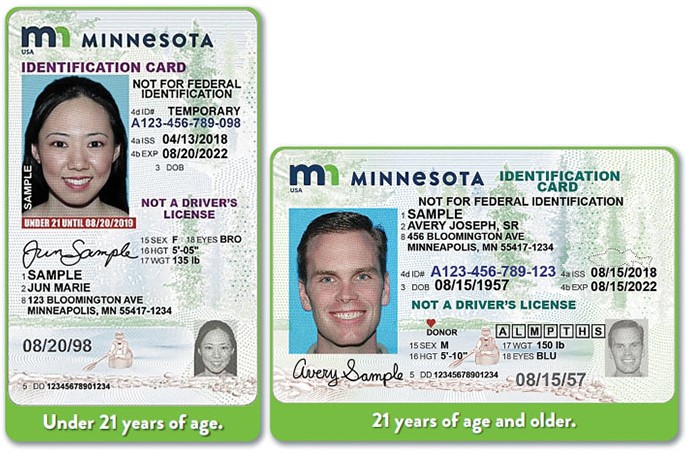
Minnesota Non-REAL ID Compliant/Standard Driver’s License

1. Who can obtain a driver’s license under the new law? 

Starting October 1, all Minnesotans can obtain a driver’s license regardless of immigration status. To get a driver’s license, an applicant who is 21 or older must prove their identity, pass the vision test, and pass the written and driving tests. The requirements for applicants who are between 16 and 21 are different. 

2. What kind of driver’s license is available under the Driver’s Licenses for All law? 

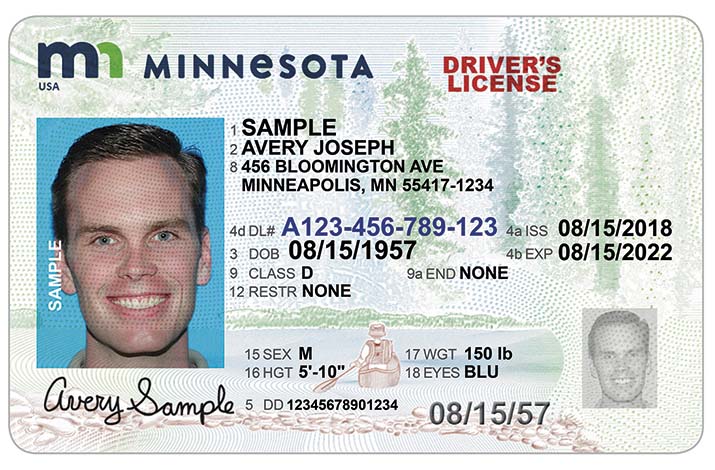
Starting October 1, all Minnesotans will be eligible for a standard Class D driver’s license regardless of immigration status (ID image above). There will be no markings on the license indicating citizenship or immigration status. 

There are two other licenses available in Minnesota: enhanced and Real ID driver’s licenses. To obtain an enhanced or Real ID license, an applicant must prove citizenship or a qualifying immigration status. 

Minnesota Identification Cards

3. What if I just want an ID but not to drive? 

A person of any age may apply for a Minnesota Identification card (ID image above). After October 1, any person of any age may apply for a Minnesota Identification card regardless of immigration status. The applicant must apply for the card and pay the required fee and present proof of identity (same types of identity documents as allowed for a driver’s license). Starting October 1, all Minnesotans will be eligible for Minnesota Identification cards regardless of immigration status. There will be no markings on the identification card indicating citizenship or immigration status. 

4. What kind of documents can be used to prove identity? 

Applicants for standard Class D driver’s licenses are already able to use the identity documents listed here to prove their identity. Starting October 1, applicants will also be able to use several foreign and immigration documents to prove their identity. These documents include the following, and the Department of Public Safety (DPS) will publish a longer list of acceptable documents closer to October 1: 

  • Foreign passport 
  • Foreign birth certificate 
  • Foreign adoption certificate 
  • Certain immigration filing and approval notices

5. It will be difficult for me to get the identity documents required for this application. What should I do? 

This law will not go into effect until October 1, 2023, so this gives you some time to gather the required documents. If you cannot get them, there may still be a way to apply for the driver’s license (through something called a “variance process”). DPS is still working out the details of some of these processes and will make more information available closer to October 1. 

6. Do I need to provide proof of citizenship or immigration status to obtain a standard Class D driver’s license? 

Starting October 1, applicants for standard Class D driver’s licenses do not need to provide proof of citizenship or immigration status to obtain a driver’s license. In fact, DPS is not allowed to ask applicants for Class D driver’s licenses about their citizenship or immigration status. 

7. I am undocumented (for example, entered the United States without a visa, entered on a visa and stayed once it expired, etc.). Can I get a Minnesota driver’s license? 

Yes. Starting October 1, proof of immigration status will not be required as a part of an application for a Minnesota driver’s license. You will need to provide the required identity documents (see question #4), but you will not need to have or prove lawful immigration status to be eligible for a Minnesota driver’s license. 

8. Does the driver’s license grant any immigration status or work authorization to undocumented immigrants? 

No. Immigration status is a matter of federal law. Driver’s licenses issued under state law do not grant immigration status or work authorization.

9. What are the privacy protections in the Driver’s Licenses for All law? 

Starting October 1, there will be strict restrictions on DPS’s ability to share information outside the agency about someone who holds a Class D driver’s license. 

First, DPS is not allowed to share any information about an individual’s citizenship or immigration status. There is one exception: DPS can share this data with the Minnesota Secretary of State (SOS) to improve voter registration records. 

Second, DPS is not allowed to share any information about individuals who have applied for or received a Class D driver’s license with ICE unless DPS is ordered by a court to do so. 

Third, if DPS shares any information outside the agency about individuals who have applied for or received a Class D driver’s license, the receiving agency must sign a certification that they will not share the information with ICE or use the information to enforce immigration laws.

10. If I got a Social Security Number for temporary purposes but it is no longer valid for work, is that the one I should list on the application? 

A Social Security Number (SSN) is not required to obtain a standard Class D driver’s license. The Driver’s License application will ask applicants to list their social security number. If you have one, you must provide it. This is true even if you do not have lawful immigration status and the SSN is not valid for work purposes. If you do not have one, you will sign attesting to not having one.

11. Should I list ITIN if I have one? 

Do not list your ITIN number in the space for the SSN. The updated Driver’s License application may ask for an ITIN number. If it asks for the ITIN number you should provide it. DPS will provide more information about this at a later date.

12. Where can I apply for the license? Do I have to do it myself? 

Minnesota Driver and Vehicle Services (DVS) has information about office locations, testing schedules, and fees for driver’s license applications available on the Minnesota DVS website. You can complete the application process in person at a DVS location or an official DVS-partner location. You can also complete parts of the application process, such as the written test, at official DVS-partner community organizations. Be sure that you are completing your own application and that you are submitting your application at a DVS location or an official DVS-partner. Applications must be submitted by the individual who is applying for the license and cannot be submitted until October 1.

13. What if I got a driver’s license in another state? 

If you got a driver’s license in another state, check the Minnesota DVS website. The answer depends on where you got the license, and whether it is still valid at the time you apply for the Minnesota license. Please ask DVS directly if you have questions after reviewing their website and/or ask an immigration attorney if you have questions about the documents you used to get the license in the other state. 

PDF Version of this FAQ – English

ILCM Spring Board Updates

ILCM is pleased to announce our new Board of Directors Chair, Sarah Radosevich! Sarah was first introduced to ILCM during college when she volunteered with us and translated educational materials into Spanish. She later joined the Board in 2019 and we are lucky to have her leadership as Chair of the Board!

Sarah Radosevich is a Government Relations Manager with General Mills, where she runs reputational and regulatory risk management processes. Before joining General Mills, Sarah was part of the policy team at the Minnesota Chamber of Commerce where she analyzed and supported advocacy efforts across a broad range of issues at the State Capitol. She received a Master in Public Policy degree from the Sanford School of Public Policy at Duke University, and her B.A. in Latin American Studies from Middlebury College. It was during a summer between years at Middlebury that she first volunteered for ILCM, translating educational materials into Spanish. Sarah joined the ILCM Board of Directors in 2019 and now serves as Chair.

We are also pleased to announce that Marielos Cabrera is our new Board of Directors Vice-Chair! Marielos joined the Board this past summer and we are looking forward to working with her in this new role.

Marielos Cabrera graduated from the University of Wisconsin-Madison and attended law school at the University of Minnesota. Marielos currently works as Health Law attorney at Fredrikson & Byron, P.A.. Before law school, Marielos worked as a paralegal at a family, criminal and immigration law firm where she saw first hand the legal barriers immigrants face. Marielos is a native Spanish speaker and the proud daughter of an immigrant father.

We also welcome Fafa Yakor and Greg Langer to our board!

Fafa Yakor has served on our Finance Committee for the last two years and is jumping right in to serve as our Treasurer. He is a Manager with EY in the Strategy & Transactions practice. He graduated from Concordia College and is a CPA. He began his career in Audit with Deloitte, and further worked as a consultant with Salo, a Korn Ferry company, and at Wells Fargo.

Greg Langer graduated from the University of Wisconsin-Madison with a B.B.A. in Accounting and his Master’s in Accountancy and earned his CPA in 2013. He works as a finance and accounting consultant for Brillect. Prior to Brillect, he served as controller for WPT Industrial REIT, a publicly traded real estate investment trust. Prior to WPT, he served as a senior manager in the manufacturing and real estate practice at KPMG where he provided audit and advisory services to a variety of firms.

Fact Sheet: Temporary Protected Status for Somalia

This fact sheet is current as of March 13, 2023. 

xaashida xaqiiqda: maqaam ilaalin ku meel gaar ah oo loogu talo galay Somaliya

On January 12, 2023, Secretary of Homeland Security Alejandro N. Mayorkas announced the extension and redesignation of Somalia for Temporary Protected Status (TPS) for 18 months. This extension and redesignation will be in effect from March 18, 2023, through September 17, 2024.  

The extension of TPS for Somalia allows approximately 430 current beneficiaries to keep TPS through September 17, 2024, if they continue to meet TPS eligibility requirements. Redesignation allows Somali nationals continuously residing in the United States as of January 11, 2023, to apply for TPS, so long as they meet all eligibility requirements.  

What is temporary protected status (TPS)? 

The Secretary of the Department of Homeland Security (DHS) grants TPS to individuals from designated countries who are unable to return home safely due to conditions or circumstances in their home countries. 

During the designated TPS period, TPS holders can live in the United States and should not be detained by DHS just on the basis of their immigration status. TPS holders are eligible to apply for an employment authorization document (EAD) and for travel authorization. 

What does the extension of TPS for Somalia mean? 

If you have TPS as a Somali national, you can apply to extend TPS. To receive the TPS extension, you must re-register for TPS by applying before May 12, 2023*. If approved, your TPS and EAD will be extended until September 17, 2024.  

*You MUST re-register during the re-registration period March 13, 2023 to May 12, 2023. Do not wait to re-register until your Employment Authorization Document (EAD) expires.  

What does the redesignation of TPS for Somalia mean?  

If you are a Somalia national and never had TPS, you can now apply for TPS for the first time. If you have lived in the United States continuously since January 11, 2023, you may apply for TPS during the registration period from March 13, 2023, until September 17, 2024. You must also meet the eligibility requirements. 

How do I apply for TPS? 

People interested in TPS must file an application with U.S. Citizenship and Immigration Services and pay the filing fee. They may also apply for an EAD and for travel authorization. All individuals applying for TPS undergo security and background checks as part of determining eligibility. More details about the eligibility criteria to submit an initial TPS application and apply for an EAD can be found in the Federal Register Notice (FRN) 

Is TPS status given automatically? 

No, TPS is not automatic. People must apply, pay a filing fee, and pass immigration screening. There are some facts that will make a person ineligible for TPS. For example, people with certain criminal convictions or who violated the human rights of others are not eligible for TPS. People who are inadmissible under certain sections of the law may have to file a waiver before they can be approved for TPS status. The application process can be complicated, and we recommend working with an immigration attorney. 

How long will eligible individuals have protection under TPS? 

TPS is a temporary status. The Secretary of Homeland Security Alejandro N. Mayorkas is designating Somalia for TPS for 18 months, until September 17, 2024. 

I am from Somalia and have TPS, can I apply to extend it? 

Yes. Under Somali TPS, individuals who already have TPS must apply to extend their TPS. 

I am from Somalia and do not have TPS, can I apply for the first time? 

Maybe. If you have continuously resided in the United States since January 11, 2023, and you are otherwise eligible, you may register for TPS during the registration period. Talk to an immigration attorney to further discuss your specific situation.  

I am from Somalia and have been in the United States since before January 11, 2023, but I have left for short periods of time. Can I apply for TPS?  

Maybe. Whether you still qualify for TPS depends on the length and nature of your time outside of the United States. Please contact an immigration attorney to discuss your situation further. 

I am from Somalia, and I came to the United States as a refugee. Do I need to apply for TPS?  

No. People who are in the United States with refugee status can live and work here and apply for permanent resident status after one year. If you have refugee status, you do not require TPS. 

I am from Somalia, and I now have a green card. Do I need to apply for TPS?  

No. As a permanent resident, you have legal status in the United States and are on a path to citizenship. You do not need and would not qualify for TPS. 

I am from Somalia, and I am in deportation proceedings. Can I apply for TPS to avoid deportation?  

Yes. A person in removal proceedings can apply for TPS, and if approved, can request that the judge put the removal case on hold until TPS is approved, and then for the time it is in effect. Talk to an immigration attorney to further discuss your specific situation. 

I am from Somalia, and the police have given me tickets here. Can I apply for TPS?  

Maybe. You should show your tickets, police reports, and court records to an immigration attorney before filing. A person with two misdemeanors or one felony conviction cannot get TPS. An attorney can tell you if the tickets will be a problem. 

Which people from Somalia should consider applying for TPS?  

People who are here with no legal status should consider applying. Also, those who are here on a visa that is for a limited time or that does not allow employment might also benefit by receiving Temporary Protected Status. Having TPS does not hurt anything. 

Get Help 

The Immigrant Law Center of Minnesota (ILCM) provides free immigration legal services to low-income immigrants in a variety of immigration matters. For more information about how we can assist you, please visit our website at www.ilcm.org or call us at (651) 641-1011. 

Printable PDF of this fact sheet

Fact Sheet: Driver’s Licenses for All – March 2023

Current as of March 14, 2023 

On March 7, 2023, Governor Tim Walz signed Driver’s Licenses for All into law. The law will go into effect on October 1, 2023. This fact sheet summarizes the new law only.  

Over the next few months, the Department of Public Safety (DPS), ILCM, and our partners will be preparing other resources to help you prepare to apply for a driver’s license. For the latest resources, please visit www.ilcm.org 

To make this fact sheet easier to read, we refer to “driver’s licenses” throughout, but state identification cards are also available under the new law. 

Who can obtain a driver’s license under the new law? 

Starting October 1, all Minnesotans can obtain a driver’s license regardless of immigration status. To obtain a driver’s license, an applicant who is 21 or older must prove their identity, pass the vision test, and pass the written and driving tests. The requirements for applicants who are between 16 and 21 are different. 

What kind of driver’s license is available under the Driver’s Licenses for All law?  

Starting October 1, all Minnesotans will be eligible for a standard Class D driver’s license regardless of immigration status. There will be no markings on the license indicating citizenship or immigration status. There are two other licenses available in Minnesota: enhanced and Real ID driver’s licenses. To obtain an enhanced or Real ID license, an applicant must prove citizenship or a qualifying immigration status.  

What kind of documents can be used to prove identity? 

Applicants for standard Class D driver’s licenses are already able to use the identity documents listed here to prove their identity. Starting October 1, applicants will also be able to use several foreign and immigration documents to prove their identity. These documents include the following, and the Department of Public Safety (DPS) will publish a longer list of acceptable documents closer to October 1: 

  • Foreign passport 
  • Foreign birth certificate 
  • Foreign adoption certificate 
  • Certain immigration filing and approval notices 

Do I need to provide proof of citizenship or immigration status to obtain a Class D driver’s license? 

Starting October 1, applicants for standard Class D driver’s licenses do not need to provide proof of citizenship or immigration status to obtain a driver’s license. In fact, DPS is not allowed to ask applicants for Class D driver’s licenses about their citizenship or immigration status. 

What are the privacy protections in the Driver’s Licenses for All law? 

Starting October 1, there will be strict restrictions on DPS’s ability to share information outside the agency about someone who holds a Class D driver’s license. 

First, DPS is not allowed to share any information about an individual’s citizenship or immigration status. There is one exception: DPS can share this data with the Minnesota Secretary of State (SOS) to improve voter registration records.  

Second, DPS is not allowed to share any information about individuals who have applied for or received a Class D driver’s license with ICE unless DPS is ordered by a court to do so. 

Third, if DPS shares any information outside the agency about individuals who have applied for or received a Class D driver’s license, the receiving agency must sign a certification that they will not share the information with ICE or use the information to enforce immigration laws.   

Printable PDF of this fact sheet.

Xaashida ay ku qoran tahay xogaha muhiimka ah ee ILCM: Laysinka Darawalnimada Dadka dhan la siiyo – Soomaali/Somali

Hoja informativa de ILCM: Licencias de conducir para Todos – Español/Spanish 

Action Alert: Say No to Ending Asylum

A new anti-asylum rule proposed by the Biden administration echoes one of the worst violations of U.S. asylum law attempted by the Trump administration. The rule attempts to bar asylum seekers who have passed through a third country from applying for asylum in the United States. This blatant violation of human rights and U.S. and international law cannot be allowed to stand.   

The government is required to review and respond to comments on the regulation in writing in the Federal Register. Click here to send a public comment before March 27. To make sure the government counts and considers your comment, please edit the pre-drafted suggestion to make it unique – duplicate comments will otherwise be lumped together and responded to as one. 

The new regulation says that any asylum seekers coming through a third country will face a “rebuttable presumption” of ineligibility. In effect, this new rule would limit asylum to Mexicans, Canadians, people arriving in small boats, and those with the money and connections to obtain visas and airline tickets.  

The “rebuttable presumption” requires asylum seekers to prove “imminent and extreme” threats to life or safety or a medical emergency. Without these exceptional circumstances, they will not even be allowed to apply for asylum. Asylum seekers, already exhausted by long overland journeys and traumatized by violence in their countries of origin and during these journeys, will find this a near-impossible challenge.  

This ban is illegal, inhumane, and dangerous. It violates U.S. asylum law, which gives any person present in or arriving in the United States an absolute right to apply for asylum. U.S. asylum law says that time spent in a third country only bars people passing through a designated ‘safe third country’ or having ‘firmly resettled’ in a third country. Neither Mexico nor any Central American country is designated as a ‘safe third country’.

 The government is required to review and respond to comments on the regulation in writing in the Federal Register. Click here to send a public comment before March 27. To make sure the government counts and considers your comment, please edit the pre-drafted suggestion to make it unique – duplicate comments will otherwise be lumped together and responded to as one. 

Driver’s Licenses for All Becomes Law!

March 7, 2023—Today Governor Tim Walz signed the legislation restoring driver’s licenses to all Minnesotans regardless of immigration status so long as they pass the written and practical tests.

This legislation increases safe legal access to our shared roads for everyone, which was the law in Minnesota until 2003.  The passage of this legislation was accomplished by the efforts of grassroots immigrant organizations, labor unions and nonprofits, business and law enforcement groups, and elected officials across Minnesota. During the debate, supporters highlighted the diverse interests in favor of this bill, including the Minnesota Chamber of Commerce, Minnesota Police and Peace Officers Association and Minnesota Police Chiefs Association, major labor organizations, and numerous immigrant-led organizations.

Speaking at the signing ceremony, ILCM Executive Director Veena Iyer thanked supporters of the bill and especially the immigrant-led organizations in the forefront of the movement, concluding: “So today, we also celebrate our democracy. One that is messy, but one in which ordinary people can come together to do extraordinary things. One in which Driver’s Licenses for All is only the first of many policies that we will pass together to make our state better for all Minnesotans regardless of their immigration status.”