Only 10,200 refugees were admitted to the United States during the fiscal year ending September 30, by far the lowest number in the history of refugee admissions. The year ahead may be even worse.
Each year before September 30, the president is required to consult with Congress about the number of refugees the Administration plans to admit in the upcoming year. Over the past four years the Trump administration has greatly shrunk the U.S. refugee program, decreasing planned annual refugee admissions from 110,000 in 2016, under the previous Administration, to just 18,000 this year.
The U.S. has historically resettled more refugees annually than all the other countries in the world combined, welcoming an average of 95,000 refugees per year. Last year, for the first time, the United States was no longer the leader in refugee admissions. When the U.S. closes its doors, other wealthy nations follow its example, and refugees remain stuck in camps and dangerous situations around the world.
Refugees are our neighbors, colleagues, and community members. In this time of crisis, over 300,000 of them have been working in front-line industries. Refugee admissions can be done safely and are a vital component of helping the world recover from the COVID-19 crisis.
The government has proposed a new rule that would strip many due process protections in deportation proceedings. The government claims the new rule would increase “efficiency.” In fact, that means speeding up deportations, and limiting the power of immigration courts. You can file a comment opposing this rule.
The government is required to allow the public to read and comment on proposed rules. Comments are public records that anyone can read. The agency proposing a new rule must read all the comments and consider. The agency may make changes to the rule after considering comments. If a large number of comments are submitted, it will take longer to publish the final rule.
The comment period for this rule ends on Friday, September 25. You can make a comment by clicking here and entering your comment. Just click on the “Comment Now” button on the right side of the page.
Here are some details about the proposed rule:
Administrative Closure: Immigration courts use administrative closure to stop a deportation case from moving forward. They can use this tool when an immigrant has an application for a visa pending. That stops the deportation case, and allows time for processing the application.
For example, an immigrant may have an application for a visa as a crime victim. These visas are called U-visas. Only a small number of U-visas are allowed each year. So someone may be approved for a U-visa, but may have to wait for years to receive it. Administrative closure puts the deportation case on hold. This allows the U-visa applicant to wait in the United States until a visa is issued. The proposed regulation would eliminate administrative closure and allow the deportation of immigrants, including crime victims, who have been approved for visas but are simply waiting for them to become available.
Reduced Fact-Finding: Right now, the Bureau of Immigration Appeals (BIA) can send a case back to the judge for more fact-finding. For example, an immigrant might not have a lawyer at first. That might mean that important facts are not presented to the court. So the BIA can send the case back for more fact-finding. The regulation would prevent the BIA from making most fact-finding orders.
This new rule is very long and very complicated. These are just two of many changes that the new rule would make. Overall, the rule changes immigration court procedures to favor deportation and handicap defense against deportation. It reduces the authority of immigration judges and the BIA to make fair decisions.
The comment period for this rule ends on Friday, September 25. You can make a comment by clicking here and entering your comment. Just click on the “Comment Now” button on the right side of the page.
If you do not want your name to appear on the public comment document, just enter your name as “anonymous anonymous.”
Here is a very short sample comment. The best comments use your own words and experiences.
SAMPLE COMMENT:
I oppose the Executive Office for Immigration Review (EOIR) rule, EOIR Docket No. 19-0022, (the “Proposed Rule”).
This proposed rule would reshape the entire immigration court system. It would restrict immigrants’ abilities to appeal decisions. It would take away second chances.
This proposed rule would eliminate many protections. It would stop immigration judges from exercising their good judgment in administrative closure. It would prevent the BIA from ordering more fact-finding in most cases.
The appeal process takes time. There is a good reason for that. Immigrants and attorneys need time to prepare evidence.
This proposed rule says it is about efficiency. Due process is a higher value than efficiency.
Do NOT remove Immigration Court due process protections. Please withdraw this proposed rule.
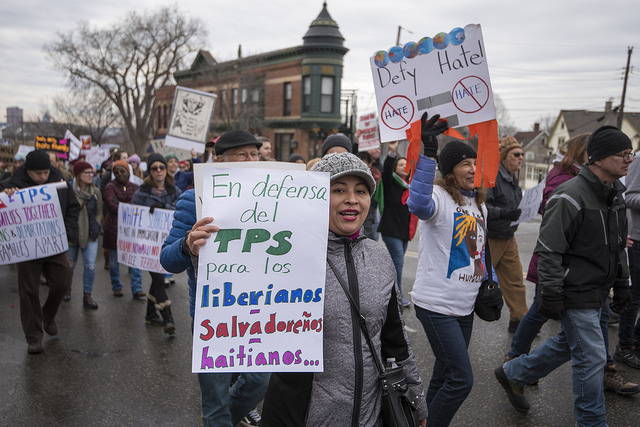
El 14 de septiembre de 2020, el Noveno Circuito anuló la orden judicial de distrito que había impedido que el Departamento de Seguridad Nacional pusiera fin al Estatus de Protección Temporal para los residentes de El Salvador, Nicaragua, Haití y Sudán. Esa decisión NO inmediatamente termina el TPS.
¿Qué es el estado de protección temporal?
El Estatus de Protección Temporal (TPS) es un estatus migratorio que brinda a los beneficiarios una autorización de 18 meses para vivir en los Estados Unidos y también ofrece un permiso de trabajo para personas de países extranjeros designados que se han visto afectados por un desastre natural, conflicto armado o otras circunstancias extraordinarias. El Departamento de Seguridad Nacional (DHS) tiene la autoridad exclusiva para designar y luego renovar o volver a designar un país para TPS.
El TPS es un estatus temporal, otorgado porque las condiciones en el país de origen impiden el regreso seguro de los ciudadanos de ese país que viven en los Estados Unidos, o porque el país de origen temporalmente no puede aceptar su regreso. Para algunos de los países designados, el TPS se ha extendido año tras año cuando las condiciones del país no han mejorado, por lo que muchos titulares de TPS han vivido en los Estados Unidos durante décadas, con fuertes vínculos con el trabajo, las familias y las comunidades.
¿Qué es una orden judicial?
Una orden judicial es una orden judicial que requiere que una persona realice o deje de realizar una acción específica. El juez puede emitirlo al principio de una demanda para evitar que el gobierno continúe con sus acciones dañinas hasta que se resuelva el caso.
¿Por qué hay casos judiciales que involucran a TPS?
En el transcurso de 2017 y 2018, DHS anunció que pondría fin a la designación de TPS de El Salvador, Honduras, Haití, Nepal, Nicaragua y Sudán. Estas decisiones afectaron a cientos de miles de personas en Estados Unidos. Se presentaron tres demandas en diferentes tribunales de los Estados Unidos para proteger los derechos de los beneficiarios de TPS. Esas demandas son Ramos v. Wolf que afecta a personas de El Salvador, Nicaragua, Haití y Sudán, Bhattarai v. Wolf que cubre a personas de Nepal y Honduras, y Saget v. Trump para haitianos que tienen TPS.
¿Qué hace la decisión del 14 de septiembre?
La decisión del 14 de septiembre es solo una decisión en una demanda: Ramos v. Wolf. Esa decisión no pone fin a la demanda. Simplemente dice que el tribunal inferior se equivocó al emitir la orden judicial, la orden que detuvo temporalmente al DHS de terminar con el TPS. La decisión NO pone fin al TPS en sí misma ni le da al DHS el derecho de terminar el TPS en ninguno de los países mencionados. El DHS no puede finalizar el TPS hasta que los casos se resuelvan finalmente. (vea el Aviso del Registro Federal del 4 de noviembre de 2019) Los abogados del caso Wolf ya están planeando apelar la decisión del 14 de septiembre. La lucha
¿Qué sucede si se termina el TPS para mi país?
Los beneficiarios de TPS NO pueden ser deportados de inmediato si finaliza el TPS. Si finalmente se permite al DHS terminar con el TPS, a todos se les dará un período de “descanso” con un permiso de trabajo y permiso para estar en los Estados Unidos durante 12 meses para los salvadoreños y cuatro meses para los ciudadanos de los otros países.
Por ahora, nada cambia. Las personas de los países afectados tienen TPS hasta el 4 de enero de 2021. Algunas semanas antes de esa fecha, el DHS hará un anuncio. Consulte el sitio web de ILCM para obtener actualizaciones.
Si tiene TPS y es de uno de los países para los que el DHS ha anunciado la intención de poner fin al TPS, es extremadamente importante que consulte con un abogado de inmigración para ver si tiene otras opciones bajo la ley de inmigración y también para mantenerse informado sobre estos juicios interconectados.
Contacta el Immigrant Law Center of Minnesota
Para recibir asistencia legal de inmigración, llame a nuestra oficina al 651-641-1011 o al 1-800-223-1368 durante las siguientes horas de admisión:
Lunes, martes y miércoles: 9 a.m. – 4 p.m.
Jueves: 1-7:30 p.m.
Visite la página de nuestro sitio web de admisión para obtener más información.
The Minnesota Department of Health (MDH) is conducting a modified Community Assessment for Public Health Emergency Response (CASPER) to understand the impact of COVID-19 on Minnesota communities. A CASPER survey is a quick way for public health workers and emergency managers to understand the needs of a community.
The information collected from a community helps:
Make informed decisions.
Initiate public health action and identify information gaps.
Facilitate disaster planning, response, and recovery activities.
Allocate resources, and assess new or changing needs.
What are the goals of the COVID-19 Public Health Survey?
Through this modified CASPER (Public Health Survey), MDH hopes to:
Understand how COVID-19 has spread in Minnesota communities.
Understand what factors influence COVID-19 infection in areas with community transmission.
Explore how COVID-19 transmission and infection rates differ among regions in Minnesota.
Identify what percent of the population is infected with COVID-19, but do not have symptoms.
Improve health messaging and prevent COVID-19 spread.
Why should you participate?
Free COVID-19 Tests: You and your household members can have free COVID-19 tests to know if you have had or currently have COVID-19.
Learn more about COVID-19: Your participation helps us better understand how COVID-19 is spreading across Minnesota. Thank you for participating! We could not do it without you. You are contributing to stopping the pandemic.
Let us know your concerns: You can speak to a public health worker about your COVID-19 concerns and its impact on your household.
What to expect during MDH’s CASPER survey:
The MDH CASPER teams plan to sample six regions. Within each selected census block, teams will systematically survey selected households. Team members will be wearing vests with nametags identifying them as part of the MDH CASPER teams. Their vehicles will also have magnets that say “COVID-19 Survey Team” on the side.
Teams will be comprised of public health workers who will conduct a survey on COVID-19 and a healthcare professional who will complete two tests:
A nasal swab test: a healthcare professional will swab the inside of your nose to see if you currently have COVID-19.
A serology test (blood test): a healthcare professional will collect a few drops of blood from your finger to see if you have previously been infected with COVID-19. This is done through a finger prick with minimal pain.
Each household will be asked to complete one survey. All household members will be asked for permission to conduct a blood and nasal swab test, and have the right to refuse both tests. Tests will be sent back to the MDH lab for analysis and individuals will be notified of their results if they choose to participate. If your test results are negative, a health care professional will send you a text message with your results. If either of your test results are positive, a health care professional will call you with your results and provide further information.
Why a COVID-19 Public Health Survey is important:
Information is key for decision-making. Information sent to the right people, at the right place, at the right time, is optimal for any successful response. A modified CASPER addresses this by providing valid information rapidly about the health needs of a community to decision-makers.
The survey results will provide information for:
Study participants on their COVID-19 infection status
MDH and local public health leadership to understand the spread and inform prevention efforts
Governor’s office to provide context for decision-making
MDH-University of Minnesota modeling team to inform COVID-19 modeling efforts
Media to educate the public
Privacy
All health information collected during the survey will remain confidential. Positive test results will be shared with the health department case investigation team to follow up.
September 15, 2020—The futures of more than 300,000 long-term U.S. residents and more than 200,000 U.S. citizen children are jeopardized by the latest court decision on Temporary Protected Status (TPS). That decision does not immediately end TPS, since further court proceedings remain. The decision does signal backing for the Trump administration’s racist moves to end TPS for Salvadorans, Haitians, Nicaraguans, and South Sudanese migrants in the United States.
Temporary Protected Status is a humanitarian protection established by Congress in 1990. The Department of Homeland Security designates TPS for people who cannot return to their home countries due to ongoing armed conflict (such as civil war), an environmental disaster (such as earthquake or hurricane), an epidemic, or other extraordinary and temporary conditions. People with TPS are not subject to deportation and can get work permits, but TPS does not give them a path to permanent residence or citizenship.
“The Trump administration’s decisions on terminating TPS have been based on racism and anti-immigrant policies, not on factual consideration of the circumstances in the countries in question,” said Veena Iyer, executive director of the Immigrant Law Center of Minnesota. “TPS holders are part of our community. They are parents, neighbors, nurses, truck drivers, construction workers, and more. We need them as much as they need to remain here.
“The Ninth Circuit decision is a setback, but it will be appealed. Moreover, legal challenges to TPS continue to make their way through courts in other jurisdictions across the country. TPS holders should know that they do NOT face immediate deportation. The battle is far from over.”
The Immigrant Law Center of Minnesota will be hosting a Facebook Live information session on TPS. Watch our Facebook page for the time and date.
Entre ahora y el 30 de noviembre de 2020, los inmigrantes y refugiados que han sido aprobados para un Documento de Autorización de Empleo (EAD) también conocido como un permiso de trabajo pueden usar el aviso de aprobación de USCIS I-765 (Formulario I-797 Aviso de Acción) para demostrar que son elegibles para trabajar si la fecha del aviso es entre el 1 de diciembre de 2019 y el 20 de agosto de 2020.
Es importante destacar que el aviso de aprobación de USCIS I-765 solo prueba la elegibilidad para trabajar. No prueba la identidad, que también es parte del proceso I-9. Por lo tanto:
Si un empleado es nuevo y está completando el proceso I-9 por primera vez, el empleado también debe presentar un documento de la Lista B que demuestre su identidad (consulte la página 3 del formulario I-9).
Si un empleado ya está trabajando para un empleador y su EAD simplemente ha expirado, el empleado solo necesita presentar el aviso de aprobación de USCIS I-765 para demostrar que todavía se le permite trabajar. No se puede pedir al empleado que presente un documento que acredite su identidad una vez más.
Para el 1 de diciembre de 2020, los empleadores deben obtener un documento de los empleados que produjeron un aviso de aprobación de USCIS I-765 para demostrar la elegibilidad para trabajar. Cuando un empleador pasa por este proceso, debe aceptar cualquier documento de la Lista A o la Lista C del empleado para probar la elegibilidad para trabajar. Un empleador no puede exigir a un empleado que presente un tipo específico de documento de la Lista A o C.
¿Qué deben saber los empleados acerca de pasar por el Proceso I-9 con empleadores en este momento?
Si su empleador se niega a aceptar el aviso de aprobación de USCIS I-765 como prueba de su elegibilidad para trabajar, puede comunicarse con:
Oficina de Prácticas de Inmigración Relacionadas con el Empleo Desleal al 1-800-255-7688 (1-800-237-2525, TTY para personas con problemas de audición).
Southern Minnesota Regional Legal Services (Servicios legales regionales del sur de Minnesota) al 1-888-575-2954
Volunteer Lawyers Network (Red de abogados voluntarios) al 612-752-6677
Immigrant Law Center of Minnesota – Oficina Legal, si es un cliente actual, al 651-641-1011
Opción uno: producir un documento que demuestre la identidad Y la elegibilidad para trabajar (documentos de la “Lista A“)
Opción dos: producir dos documentos, uno que acredite la identidad (documentos de la “Lista B“) y otro documento que acredite la elegibilidad para trabajar (documentos de la “Lista C“)
Un empleador debe aceptar cualquier documento de la Lista A O un documento de la Lista B y de la Lista C. Un empleador no puede exigir a un empleado que presente un tipo específico de documento de la Lista A, B o C.
Un EAD demuestra identidad Y elegibilidad laboral. La mayoría de los inmigrantes y refugiados que tienen un EAD presentan su EAD durante el Proceso I-9 para probar su identidad Y su elegibilidad para trabajar.
Un EAD se otorga por un período de tiempo específico y debe renovarse antes de que expire. Cuando un EAD vence, un empleador debe pedirle a un empleado que presente un documento que demuestre que el empleado todavía puede trabajar en los Estados Unidos.
Por lo general, un aviso de aprobación de USCIS I-765 no es aceptable para demostrar que el empleado todavía puede trabajar en los Estados Unidos. De hecho, el aviso dice que no es evidencia de autorización de empleo. En su lugar, debe producirse el EAD real. Sin embargo, como se discutió anteriormente, se ha hecho una excepción temporal a esta regla desde ahora hasta el 30 de noviembre de 2020.
Between now and November 30, 2020, immigrants and refugees who have been approved for an Employment Authorization Document (EAD) also known as a work permit can use the USCIS I-765 approval notice (Form I-797 Notice of Action) to prove they are eligible to work if the date on the notice is between December 1, 2019 and August 20, 2020.
Importantly, the USCIS I-765 approval notice only proves work eligibility. It does not prove identity, which is also part of the I-9 process. Therefore:
If an employee is new and is completing the I-9 process for the first time, the employee must also produce a List B document proving identity (See page 3 of the I-9 form).
If an employee is already working for an employer and their EAD has simply expired, the employee need only produce the USCIS I-765 approval notice to show they are still permitted to work. The employee cannot be asked to produce a document proving their identity once again.
By December 1, 2020, employers must obtain a document from employees who produced a USCIS I-765 approval notice to prove work eligibility. When an employer goes through this process, it must accept any List A or List C document from the employee to prove work eligibility. An employer cannot require an employee to produce a specific kind of List A or C document.
What should employees know about going through the I-9 Process with employers at this time?
Option One: Produce one document that proves identity AND work eligibility (“List A” documents)
Option Two: Produce two documents, one document that proves identity (“List B” documents) and another document that proves work eligibility (“List C” documents)
An employer must accept any List A document OR a List B and a List C document. An employer cannot require an employee to produce a specific kind of List A, B, or C document.
An EAD proves identity AND work eligibility. Most immigrants and refugees who have an EAD produce their EAD during the I-9 Process to prove their identity AND their eligibility to work.
An EAD is granted for a specific period of time and must be renewed before it expires. When an EAD expires, an employer is required to ask an employee to produce a document that shows that the employee is still permitted to work in the United States.
Usually, a USCIS I-765 approval notice is not acceptable to show the employee is still permitted to work in the United States. In fact, the notice says it is not evidence of employment authorization. Instead, the actual EAD must be produced. However, as discussed above, a temporary exception has been made to this rule between now and November 30, 2020.
These nonprofit organizations serve Minnesotans and communities across the state — from those removing barriers to housing and food, to organizations ensuring health equity and justice through policymaking – and they see the stark realities facing thousands of Minnesota children, families and people of color.
Their message was reminding representatives that Congress is in a powerful and unique position – and must take strong action, as they did earlier in this crisis and in past recessions — to meet the challenges of this moment and to jump-start a more equitable economic recovery.
“As a community of nonprofits, we are driven to taking action to create a world where we can fulfill our missions, and all Minnesotans can thrive,” said Policy Director Marie Ellis of the Minnesota Council of Nonprofits. “Congress’ failure to continue responding to our communities’ needs is deepening racial inequity and will result in a deeper and longer-lasting recession. There is a narrow window of opportunity for acting before the challenges get worse.”
While previous policy actions like the CARES Act were vital, they have proven insufficient, and the situation is worsening:
The number of Minnesotans turning to food assistance through SNAP has increased 14 percent.
More households are falling behind on rent, with 16 percent of Minnesota households in that boat.
And the unemployment rate is higher than at any time during the Great Recession.
Liz Kuoppala, executive director of MAHUBE-OTWA Community Action Partnership summed it up well: “We tell our families and seniors, and they tell us, that we cannot give up on each other. Not when winter is around the corner and homes will need to be heated and driveways shoveled, not when school schedules are uncertain, not when so many people are out of a regular paycheck, and certainly not when it seems there’s no end in sight.
“We cannot afford to have Congress give up on us either. Government action is one of the many ways we care for each other in this country. Our struggling families and seniors are resilient and resourceful – we call on Congress to invest in their potential. We need all hands-on deck to weather this economic and health crisis.”
“Hunger Solutions serves every county in the state of Minnesota and we are seeing the impact of the pandemic everywhere,” said executive director Colleen Moriarty. “The loss of a job and unemployment insurance and the threat of losing a home is magnified by thousands when you also don’t have enough food to feed your family. The MN Food HelpLine has had four times as many calls as this same time last year. People are finding themselves increasingly desperate for assistance now.”
Susan Leppke, of Minnesota Doctors for Health Equity pointed out, “The pandemic is showing us more than ever that housing is a critical part of health equity, and Black, Brown, and Indigenous Minnesotans are bearing the brunt of both the health and displacement impacts. Congress has an opportunity and a responsibility to provide for more adequate funding to help us not only survive this crisis, but emerge with a more equitable system for all communities.”
“We need Congress to get back to work and support increasing Medicaid funding and provide housing assistance funding so that states can continue to make affordable health care work for all who need it,” Leppke said.
And at a time when the public is calling for racial equity these harmful repercussions are affecting our neighbors of color much more deeply, so policy solutions must explicitly dismantle our racist systems.
“Covid has only revealed what we already knew about racial disparities: that government inaction is a matter of life and death for communities of color, indigenous communities, and communities experiencing low wealth,” said Voices for Racial Justice Research and Policy Director Brett Grant. “Covid and the recent uprisings were a test for us and for our Government. Would we be able to look past our ideological and philosophical differences and simply do the right thing? Or, would we continue to let ideological and philosophical differences lead us down a path of inaction? All across the country, we saw communities move past their differences and respond to this pandemic with dignity, love, care, respect, and practices of selflessness, demonstrating the best of who we are and who we hope to be as a nation…Our governments have a lot to learn from these examples.”
Additional comments from nonprofit leaders focused on specific communities and nonprofits as a sector and employers in our communities.
“Human service non-profits historically see the impact of crisis and trauma long after the event has occurred. Minnesotans will be suffering for a long time, even once the pandemic is under control,” said Judy Halper, CEO of Jewish Family and Children’s Service of Minneapolis. “Jewish Family and Children’s Service of Minneapolis, along with other people-serving organizations anticipates that the length of this disruption combined with the ongoing challenge of re-employment and regaining sustainability will result in greater, complex needs, and more resources will be needed to meet them.”
“Wolf Ridge Environmental Learning Center is the largest accredited facility of its kind in the nation and serves more than 12,000 Minnesotans from approximately 100 different communities in the state, according to Executive Director Pete Smerud. “As a previously 87% earned income nonprofit we’ve lost 99% of that earned income since March 13 and are now preparing for no return to onsite gatherings until mid-2021. This financial condition puts the Wolf Ridge ELC, also the 8th largest employer in Lake County, in a perilous financial condition. The same condition exists for residential environmental centers all over the state of Minnesota.”