





Sorting out the Dream Acts

The Dreamers – young people who grew up here after being brought to the United States as children — are under attack again. After Congress tried and failed to pass the Development, Relief, and Education for Alien Minors (DREAM) Act over and over again, President Barack Obama acted to protect these young people. In 2012, he established the Deferred Action for Childhood Arrivals (DACA) program. Young people who qualified for DACA received temporary protection from deportation and permission to work, renewable under new presidential orders every two years.

That was then. Trump is now. As a candidate, he said he would end DACA. As president, he has waffled back and forth. Now Texas and nine other states, in a letter to the president from the states’ attorneys general, have threatened to sue if the administration doesn’t start phasing out the program by September 5. On the other side, 20 state attorneys general have written to the president asking him to protect DACA, as have 42 U.S. Senators.

While he was Secretary of Homeland Security, John Kelly said that, even though he personally supported DACA, there might be no legal grounds to support it in court. Now Kelly, a strong anti-immigrant voice within the administration, has moved up to a position as White House Chief of Staff.

Meanwhile, the Dream Act is alive again in Congress. On July 20, 2017, Senators Lindsey Graham (R-SC) and Dick Durbin (D-IL) introduced the Dream Act of 2017. A week later, two bills were introduced in the House of Representatives that would protect also Dreamers – the bipartisan Dream Act of 2017, introduced by Ileana Ros-Lehtinen (R-FL) and Lucille Roybal-Allard (D-CA), and the American Hope Act, introduced by Nancy Pelosi (D-CA), Congressman Luis Gutierrez (D-IL) and the Congressional Hispanic Caucus.

The National Immigration Law Center (NILC) published a side-by-side comparison of the 2010 and 2017 Dream Acts and DACA, which generally shows the 2017 Dream Act as more inclusive than DACA or the 2010 legislation. I haven’t seen a comparison of the 2017 Dream Act and the American Hope Act. Any Dream Act version, however, would provide legal protection for Dreamers and current DACA recipients, rather than leaving them subject to the whim of the president.

Most Americans support Dreamers. A Morning Consult/Politico poll showed strong support for Dreamers, all along the political spectrum:

“In a Morning Consult survey from late April, almost 4 in 5 (78 percent) registered voters said the Dreamers should be allowed to stay in the country, with more than half (56 percent) expressing support for eventual citizenship….

“There was also broad support in favor of the Dreamers among the voters who helped elect Trump in November: 73 percent of those voters said the Dreamers should be allowed to stay in the country, with almost half (48 percent) of those voters also saying they should have a path to becoming U.S. citizens.”

Would any Dream Act have a chance of passage in this Congress? And if a Dream Act passed, would the president sign it? In today’s chaotic national political scene, that’s impossible to say.
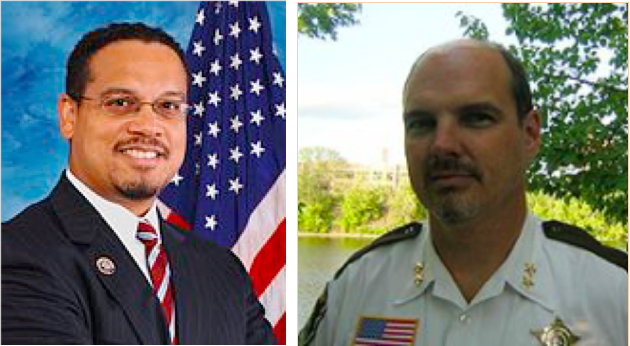

Ellison questions Stanek policies on immigrants

Minnesota Congressional Representative Keith Ellison is challenging Hennepin County Sheriff Rich Stanek over jail policies that help Immigration and Customs Enforcement (ICE).

Stanek’s jail policies help locate and deport immigrants, whether they are documented or undocumented. Whenever a foreign-born inmate is booked into Hennepin County Jail, the jail alerts ICE, according to a July 26 report in the Star Tribune:

“When deputies book inmates, they ask for their city of birth and citizenship. Stanek says inquiring about birthplaces is required by Minnesota statutes and allows his office to notify consulates. With foreign-born inmates, deputies call ICE and sometimes put that inmate on the phone with an ICE agent.

“The jail also provides ICE agents space to meet with inmates and notifies the agency when an inmate with an ICE detainer is about to be released.”

Sheriff Stanek does not hold inmates past their scheduled release date on ICE warrants, which have been held unconstitutional by a number of courts.  Instead, his practice seems to go one step beyond the warrant procedure in helping ICE locate and deport people.

Now Minnesota Congressional Representative Keith Ellison is asking for answers from Stanek about exactly what is asked and whether prisoners are advised of their right not to talk to ICE or given access to an attorney before being questioned by ICE agents. Specifically, Ellison wants answers by close of business on Friday, July 28 for the following questions:

  1. What access to Hennepin County sheriff’s Office (HCSO) inmate databases and other booking information does ICE receive? How regularly is this information provided, and on what grounds?
  2. Please list the questions that all detainees booked at Hennepin County jails and detention facilities are asked as part of standard intake procedures, as well as the point in the process when ICE is notified, how they are notified, and how communication with ICE is tracked.
  3. It was reported on July 7, 2017 that when HCSO deputies book inmates, they inmates for their country of birth and citizenship information. On what legal basis are your deputies soliciting this information from people booked at your facilities? What notification, if any is given to inmates about whether they are required to submit the information?
  4. The same report stated that with foreign-born inmates, HCSO deputies call ICE and sometimes put the inmate on the phone with an ICE agent or bring ICE to question them in person. What notification, if any, are detainees given that they are not required to speak with ICE either over the phone or in person?
  5. What percentage of detainees who are interviewed by ICE at your office receive legal representation during or prior to these interrogations?
  6. How and when does transfer of detainees to ICE custody happen? Please describe the chain of actions that HCSO takes to facilitate transfer of HCSO detainees to ICE custody.
  7. In 2016, how many total estimated hours did HCSO staff spend assisting ICE, or other federal immigration enforcement agencies?
  8. Hennepin County is estimated to have spent nearly $1.5 million on detaining undocumented immigrants in 2015 alone, according to the National Institute of Corrections and the Department of Justice.
    What is the estimated overall cost of HCSO staff time spent assisting ICE and other federal agencies with federal immigration enforcement for the current fiscal year?

Immigration advocates, public defenders, and a host of other critics want a change in the jail’s policies. That seems unlikely to happen. According to the Star Tribune article, even the County Board can’t tell Sheriff Stanek what to do:

Over the past year, [Public Defender] Moriarty and advocates such as John Keller at the Immigrant Law Center have asked Stanek to stop sharing information with ICE. Commissioner Greene’s office explored ways of preventing sheriff’s employees from doing so, but the County Board has no authority over Sheriff’s Office policy.


What happens to DACA on September 5? ILCM and Navigate answer.

What’s going to happen on September 5? That question was on many minds on the sunny Saturday morning in El Colegio’s cafeteria, one of many questions at the Navigate/Immigrant Law Center of Minnesota policy/legal update. September 5 is the deadline set by the Texas attorney general’s letter to President Trump. The letter, signed by ten state attorneys general, threatens legal action to overturn DACA unless the president agrees to phase out the program.

The September 5 date is a threat, not a legal deadline, ILCM director John Keller said on July 22. This is a political moment. No one knows exactly what will happen.

On July 21, 20 state attorneys general, including Minnesota Attorney General Lori Swanson, responded to the threat. They wrote to Trump to defend DACA. That’s twice as many state attorneys general defending DACA as those who signed on to the Texas attorney general’s letter attacking DACA.

There could be several scenarios ahead for DACA, Keller explained. Despite the Texas threat to file suit on September 5 to end DACA, the possibilities remain the same as those talked about since the election:

  1. The president could defend and protect DACA and it could continue as it has – he could order the U.S. Attorney General to defend DACA against lawsuits or he could pressure the 10 Republican state attorneys general to stop their lawsuit.
  2. The president could modify DACA and say that only those who have applied prior to a certain date could receive DACA and continue to renew work permits, but that no new applications would be granted.
  3. The president could say that no new applications would be accepted, and that people who have DACA can use their work permits only until they expire and not renew them.
  4. The president could shut down on DACA on a specific date and cancel work permits as of that date.

In the worst case scenario, asked one person, what should a person with DACA do?

“If you have not had a comprehensive consultation with an immigration attorney in the past year, do that,” Keller said. “Consult an immigration attorney to see if there is any additional protection that might be available to you. Do that even if you have worked with an attorney on your DACA. It’s still worth a legal update or a legal check-up to see if there is any new scenario that would be helpful.”

Keller began the July 22 policy/legal update with thanks for the work that Navigate-MN does in the community. While ILCM represents immigrants in courts and immigration proceedings, he said that its work is political as well, focusing on advocacy for immigrants and refugees in the state and national political arenas along with Navigate and other organizations.

The Saturday morning meeting, which focused specifically Deferred Action for Childhood Arrivals (DACA) and Temporary Protected Status (TPS), was part of ILCM’s third focus: education. ILCM’s education work includes Know Your Rights workshops for immigrants and refugees, community education about legal and political immigration issues, and education of the larger community about immigrants and refugees.

On July 22, Navigate organizers emphasized the need for political organizing and building political will to defend immigrants and refugees.

“We didn’t get DACA because of the goodness of Obama’s heart, but because of organizing and building power in the community,” an organizer said. She emphasized that, while defending DACA is crucial, people also need to defend the future of the larger immigrant community.

Dream Act: One more time

Accredited Legal Representative Gail Martinson (left) helped Islam and Carolina apply for DACA status. Since receiving DACA, they have both graduated from school as certified nurse assistants, and have been able to get driver’s licenses, buy their first house, and begin payment for their son’s heart surgery.

They grew up here, went to school here, work here, pay taxes here, raise their own children here – let them become citizens. That’s the gist of the latest Dream Act, unveiled Tuesday (July 20) by Senators Lindsey Graham (R-SC) and Dick Durbin (D-IL). According to their one-page summary:

The Dream Act would allow these young people to earn lawful permanent residence and eventually American citizenship if they:

  • Are longtime residents who came to the U.S. as children;
  • Graduate from high school or obtain a GED;
  • Pursue higher education, work lawfully for at least 3 years, or serve in the military;
  • Pass security and law enforcement background checks and pay a reasonable application fee;
  • Demonstrate proficiency in the English language and a knowledge of United States history; and
  • Have not committed a felony or other serious crimes and do not pose a threat to our country.

This Dream Act is a successor to about a dozen earlier Dream Acts. Senator Dick Durbin and Senator Orrin Hatch (R-UT) introduced the first one in 2001. A 2010 version passed the House of Representatives, which then had a Democratic majority, but couldn’t pass the Senate.

Continuing failure to get  a Dream Act passed led to President Obama’s 2012 action establishing Deferred Action for Childhood Arrivals, more often known as DACA. Only Congress can establish a path to legal permanent residence and citizenship, so DACA works only as an order to defer deportation and allow a two-year work permit. DACA allowed two-year renewals of status in 2014 and 2016. Currently, about 800,000 young people have DACA protection.

DACA is under threat from a group of states led by Texas, who say they will mount a legal challenge to end DACA unless the president stops all renewals and new applications by September 5. It’s not clear whether the Trump administration will instruct the attorney general to defend DACA against such a lawsuit.

Despite Trump saying last week that Congress should solve the problem of Deferred Action for Childhood Arrivals (DACA) recipients through legislation, his aides said yesterday that he would oppose the Dream Act legislation.

For more information:

Here is the draft of a new ‘DREAM Act’ that Trump is already rejecting (McClatchey, 7/20/17)

“These kids are running out of asphalt. They’re running out of runway,” Graham of South Carolina said Thursday when announcing the legislation. “They came out of the shadows at the invitation of their government. They’ve identified themselves and their legal standing is now in question. It becomes an almost moral decision.”

Trump’s Sympathy For Dreamers Doesn’t Extend To Actual Legislation To Help Them (Huffington Post, 7/20/17)

“Graham said he thinks many Republicans would be in favor of allowing Dreamers to stay, especially if Kelly presented them with a plan to secure the border and deport criminals and other bad actors. If Trump assured the public the border was secure, Graham said, Republicans would believe him and be more willing to move forward.”

Valdez: Does this new, bipartisan Dream Act stand a chance? (Arizona Central, 7/19/17)

“Bipartisan compassion. Believe it or not.

“Can this thin vapor survive in an atmosphere thick with the venomous smoke of far-right wrath?

“The future of hundreds of thousands of young people depend on its survival. So does the soul of a great country.”

Graham tells Republicans “moment of reckoning” is coming on Dream Act (CBS, 7/20/17)

“The question for the Republican Party is, what do we tell these people? How do we treat them? Here’s my answer. We treat them fairly. We do not pull the rug out from under them,” Graham said, adding those immigrants, “are no more connected with a foreign country than I am.”

“So to President Trump, you’re going to have to make a decision,” Graham said. “The campaign is over. To the Republican Party, who are we? What do we believe? The moment of reckoning is coming. When they write the history of these times, I’m going to be with these kids.”

Durbin, Graham file Dream Act, hoping to ward off legal challenge to DACA (Washington Post, 7/20/17)

“Durbin said he is actively engaged with the White House on the issue. He first filed “dreamer” legislation 16 years ago; other versions passed the House in 2010 and in the Senate, as part of a larger immigration bill, in 2013. But no bill has ever been passed by both chambers.”