




Trump killed DACA. Now he says Congress should resurrect it.
Archives
DACA Helpline

 (Español abajo.) The helpline is open again this week! Minnesota immigrants and refugees with household income below 250% of the federal poverty guidelines can call for free legal consultation on DACA. Call 651-287-3715 from 10-noon on Tuesday and from 2:30-4:30 on Thursday. (Income screening will be done over the phone.)
La linea de derechos para inmigrantes y refugiados estará abierta otra vez durante esta semana! Inmigrantes y refugiados que viven en el estado de Minnesota y que tienen un ingreso debajo del 250% de las guías federales de pobreza pueden llamar a la linea telefónica para una consulta (gratuita) relacionada con DACA. Llame a 651-287-3715 el martes entre la 10 de la mañana y el mediodía y el jueves entre las 2:30 y las 4:30 de la tarde. (Una evaluación de ingresos se tomará lugar por teléfono.)
A Tale of Two Citizens

After traveling a long, hard, and costly road, Licette Peña Paulino became a U.S. citizen this year. She waited for almost a decade to get a visa. After becoming a permanent legal resident, she had to wait five years to apply. Application fees total $725 now. After applying she had to wait again – for processing of papers and background checks and scheduling the naturalization interview and tests.
Along the way, Licette got help with the application and test preparation from Graciela Gonzalez, her pro bono attorney with the Immigrant Law Center of Minnesota, who is also an immigrant. Licette said she is grateful to the Immigrant Law Center of Minnesota, whose staff and volunteers made her feel “very welcome and not afraid through the process of becoming a citizen.”
Many years ago, Licette’s parents applied for her visa under the family reunification provisions of current U.S. immigration law. Then they waited – her parents here and Licette in the Dominican Republic, where she was a medical doctor. She was eight months pregnant when she received her visa. Coming to the United States with her husband and two children in September 2010, she gave birth to their third child in October.
Without speaking English, everything seemed frightening at first. She started English classes in November 2010.
Though Licette was a medical doctor in the Dominican Republic, her Dominican medical education and credentials weren’t recognized here. She had to look for other work. She now works as a personal care attendant. When she explored nursing classes through a community college, the process seemed bureaucratic and complicated. She is now preparing to become a physician’s assistant.
Licette’s desire to come to the United States and become a citizen began with the stories of friends who had visited here. Her parents came to the United States in search of work and a better life. She wanted that for herself and her children, too.
Now that she is here, Licette says she appreciates the order and relative security of living where people follow the rules. She is also glad that when she works, she has the materials she needs for her work—something we often take for granted.
She and her father prepared for citizenship together. Besides learning English, they had to pass a citizenship test with questions on American government, history and civics. The application process is expensive, but she and her father qualified for pro bono assistance from the Immigrant Law Center of Minnesota. Graciela Gonzalez, her attorney. “was wonderful,” Licette said.
Graciela Gonzalez recounts a similar journey. She came to the United States from Argentina and earned her B.A. from the University of Minnesota with majors in English and political science. She began her career as a certified interpreter in federal and state courts, and in immigration courts. She also taught “Interpreting in Legal Settings” at the University of Minnesota for many years. After her children left home, she earned a law degree from the University of St. Thomas and now practices immigration and criminal law. She also volunteers pro bono services at the Legal Rights Center, a non-profit organization that represents, free of charge, indigent and low income criminal defendants.
Graciela said it gives her great joy to help immigrants like Licette find their way through the paperwork, interviews and tests required to become a U.S. citizen. Naturalization is a moment of great emotion, as an immigrant steps into a new identity without giving up their native culture. Becoming a U.S. citizen is a process of addition, not substitution or subtraction. Welcoming new citizens enriches the United States.
Thanks to Newell Searle, a volunteer for ILCM, for writing this article.
Juventino Meza: ‘I’m ready for what’s to come.’

#WinterIsHere and not just on Game of Thrones. Might not look like winter outside, but a bitter cold wind is blowing out of Washington these days for Juventino Meza, and for other Dreamers.
“A piece of paper has never defined me and having it be taken away will be hard but I’ve been there before,” Juve wrote recently. “We have been there before. Many are there now. What we do under these circumstances is important and I hope we choose to fight like hell for young people and our entire families- for ALL of us. I’m ready for what’s to come. I hope you are too.”
Juve has been fighting for years. After growing up in Jalisco, Mexico, he came to Minnesota as a fifteen-year-old. Besides adjusting to a new language and culture, he coped with high school bullying that targeted his immigration status and his sexual orientation. High school was tough, but Juve was tougher. He led student organizing for the Minnesota Dream Act, which passed during his senior year, and won a scholarship to attend Augsburg College.
Juve was the first in his family to go to college. His father and other relatives worked construction, and older siblings dropped out of high school. Interviewed by MPR in 2008 for an article about first-generation college students, he said:
“A lot of people also have generalized things like ‘Oh, you Mexicans are really hard workers.’ But I like to think of myself as ‘No, I’m a lazy bum’ or ‘I like to sit and read.’ And when that actually takes you further than working so hard, I feel like I’m capable just like anyone else, to be able to become a CEO or start my own organization.”
While still in college, Juve co-founded and became the first executive director of NAVIGATE-MN, a non-profit organization that works on behalf of undocumented youth. After graduating from college, he worked as a policy coordinator for the Citizens League, was a Humphrey School of Public Affairs public policy fellow, worked for the Minneapolis Pubic Schools, and is now enrolled in Mitchell Hamline School of Law.
“I’ve lived in the U.S since I was a teenager and only have had DACA for less than 5 years,” Juve wrote recently. “I went to college without the Minnesota Dream Act or DACA or access to health insurance. My entire adulthood has been managing to survive the awfulness of racism, homophobia, and anti-immigrant prejudices in this country and find hope every single time… and sometimes doing something good with others.”
Along with more than 6,000 young immigrants in Minnesota and more than 800,000 across the country, Juve now has DACA status – Deferred Action for Childhood Arrivals. His organizing and advocacy work was part of the push that led President Obama to establish DACA in 2012, and the Minnesota legislature to pass the Minnesota Dream Act in 2013.
DACA is not a permanent status, but has been renewable every two years since 2012. DACA recipients do not have a path to permanent residence or citizenship, but do have temporary protection from deportation and work permits. Now President Trump is considering ending DACA, a move that Juve says would cause “a lot of unnecessary pain.”
Juve is still working with NAVIGATE-MN, organizing and advocating and offering help and support. Some of the resources he recommends, now that #WinterIsHere are:
- What Do I Need to Know if the DACA Program Ends? (August 28, 2017): https://www.ilrc.org/what-do-i-need-know-if-daca-program-en…
- UndocuHealing Project: http://www.undocuhealing.org/elevating-the-soul-guide.html
- National Suicide/Crisis Hotline:
1-800-273-8255
Crisis Text: 741741 - Also know that even if your DACA is taken away, there are other ways to go to college and legally work:
– In Minnesota, the MN Dream Act remains intact. Some provisions that provide benefits over working requirements may be affected (work study) but overall, the program remains intact. ohe.state.mn.us/mndreamact/
– You can become an entrepreneur and create your own company–your company gets hired. Reach out to ledc-mn.orgfor more information. - Orgs to support:
Navigate MNnavigatemn.org
www.ilcm.org - Take action via Immigrant Law Center of Minnesota:
http://www.congressweb.com/ILCM/33
DACA, explained: why Donald Trump holds the fate of a generation of immigrants in his hands
Some questions about DACA are basic — What is DACA? Who are the Dreamers? Some are complicated — What’s the difference between being “lawfully present in the US” and “having legal status? This Vox article has the answers.
Jeff Flake: We need immigrants with skills. But working hard is a skill.
Defending the Dreamers: Looking to DACA and the future
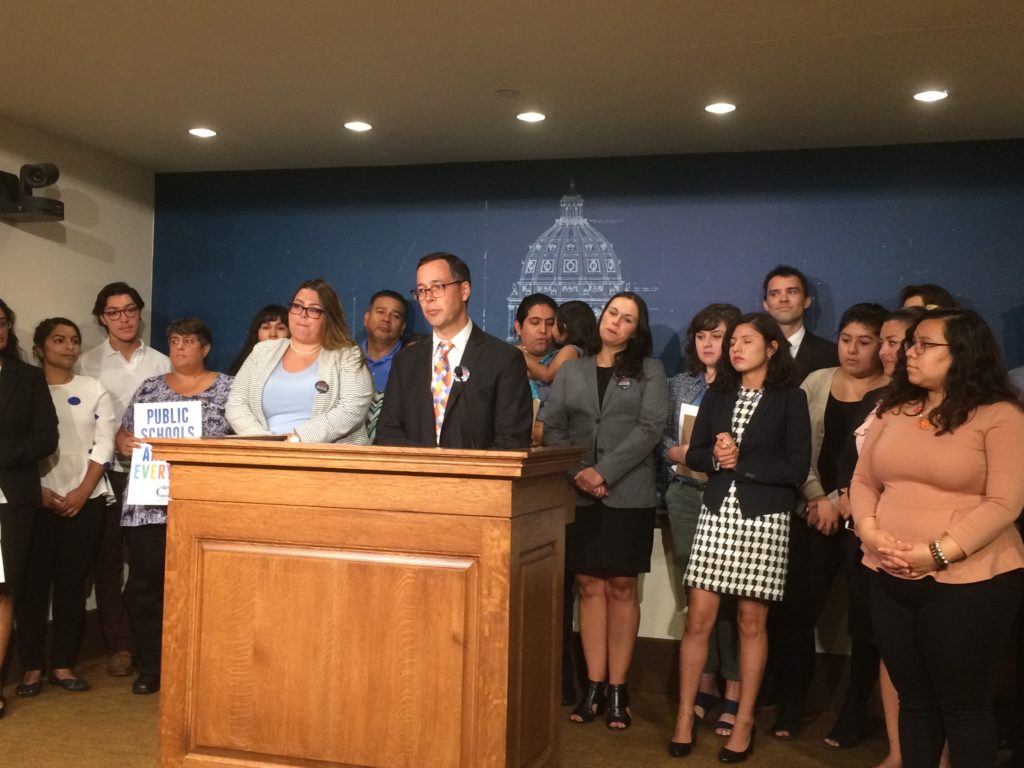
Five years ago, John Keller recalled, people started lining up at Green High School in Minneapolis at 10 p.m. on the night before the first DACA information meeting. Some 700 people packed the meeting the next day, as the Immigrant Law Center of Minnesota (ILCM) and Navigate-MN helped them begin the process of applying for DACA – Deferred Action for Childhood Arrivals. Then and now, DACA changes lives, protecting young immigrants from deportation for two years, and giving them work authorization and social security numbers.
ILCM Executive Director John Keller, Navigate-MN Executive Director Emilia Gonzalez Avalos, and Mirella Ceja-Orozco of the American Immigration Lawyers Association Minnesota chapter spoke at a press conference at the Minnesota State Capitol on August 15 to mark the fifth anniversary of DACA, along with DACA supporters and advocates and recipients.
Uriel Rosales-Tlatenchi is one face of DACA. He crossed the border with his parents 18 years ago, when he was only 9 years old. Uriel grew up in Minneapolis, graduated from the University of Minnesota-Twin Cities, and was one of the first DACA applicants in Minnesota. He vividly recalls his continuing fear of deportation.
He became an activist, working as the first executive director of Navigate-MN to advocate for legal status for Dreamers – the young people who grew up in the United States without legal status. In 2012, President Obama instituted DACA, which provides a limited, temporary status with no path to legal permanent residence or citizenship. Only Congress can provide that path.

When Uriel got DACA status, he says, “I was no longer afraid.” He could get a driver’s license, and could work in whatever field he chose. Since then, he has married and has a two-and-a-half year old son. He works, pays taxes, and contributes to the state with his civic involvement.
Across the country, nearly 800,000 young people have gained DACA protection during the past five years. In Minnesota, ILCM has helped more than 3,000 young people through the DACA application process. By the end of March 2017, some 6,255 Minnesotans had gained DACA protection, coming from every congressional district in the state.
Young immigrants, who were brought here by their parents before they turned 16 and were younger than 31 on June 15, 2012, may be eligible for DACA. They also need to meet other qualifications, apply, pay fees, and pass a background check.
Like Uriel, 92 percent of DACA recipients are either employed or enrolled in school and 90 percent have either a drivers license or state ID. Some 54 percent have purchased their first car and 12 percent are first-time home buyers. Six percent have started their own businesses, a rate of entrepreneurship nearly double that of native-born citizens.
DACA authorization is good for two years – then it must be renewed. The program itself also has to be renewed every two years. The next time it’s up for renewal is 2018, and nobody knows what Trump will do. He has threatened to end DACA, promised to protect the young people with DACA status, and generally left everyone uncertain of what to expect. DACA currently faces a legal challenge from Texas and nine other states. Will the Department of Justice defend DACA in court? Again – no one knows what to expect from this administration.
If the president decides to end DACA or if the Texas-led state attack succeeds, almost 800,000 young people will be suddenly deportable. The impact on the national economy would be huge. According to the Cato Institute’s estimate:
“[A] repeal or roll-back of DACA would harm the economy and cost the U.S. government a significant amount of lost tax revenue. We estimate that the fiscal cost of immediately deporting the approximately 750,000 people currently in the DACA program would be over $60 billion to the federal government along with a $280 billion reduction in economic growth over the next decade.”
“The State of Minnesota needs every last immigrant and every last DACA recipient,” said John Keller. He cited studies showing that Minnesota, DACA recipients pay an estimated $15 million in taxes every year, and that ending DACA would reduce Minnesota’s Gross Domestic Product by $367 million per year.
Most Americans support Dreamers. A Morning Consult/Politico poll showed strong support for Dreamers, all along the political spectrum:
“In a Morning Consult survey from late April, almost 4 in 5 (78 percent) registered voters said the Dreamers should be allowed to stay in the country, with more than half (56 percent) expressing support for eventual citizenship….
“There was also broad support in favor of the Dreamers among the voters who helped elect Trump in November: 73 percent of those voters said the Dreamers should be allowed to stay in the country, with almost half (48 percent) of those voters also saying they should have a path to becoming U.S. citizens.”
Protecting DACA is a first step, but Dreamers need permanent status that can come only with passage of the DREAM Act by Congress, establishing a path to permanent legal residence and citizenship.
x x x x
Trepidation in the Heartland
Farmers and food processors worry anti-immigration policies will harm their businesses—and Minnesota.
What’s in the latest Republican anti-immigration legislation?

Though it has little chance of passing, the Raise Act sponsored by two Republican senators and endorsed by the president has already raised the level of fear and confusion over immigration in the United States. Its provisions privilege English-speaking immigrants at the expense of family reunion visas and refugees. Overall, legal immigration would be cut in half. Refugee admissions would be permanently reduced to 50,000 per year. Except for spouses and minor children, family-related visas would be abolished. The diversity visa program would be abolished.
Touted as “merit-based,” the Raise Act defines merit based on a point system. Prospective immigrants would get points for:
- Age – best age? Prospective immigrants get 10 points for being 26-31 years old. Worst age? Immigrants over 51 get zero points for age.
- Education – generally, more education gets you more points. A U.S. bachelor’s degree counts for more than a foreign bachelor’s degree, and advanced STEM degrees pile on even more points. Advanced degrees in the humanities or in social sciences or law: zero points.
- Speaking English – higher proficiency scores mean more points.
- Extraordinary achievement – science awards count for more than Olympic medals, but both count for a lot. Nobel Peace Prize? Nobel Prize for literature? Sorry – no points for those.
- Job offering – in general, higher salaries mean more points, but you don’t get any points unless you have a college degree.
- Investment in a new commercial enterprise – Got millions? You get six points for agreeing to invest $1.35 million and twelve points for $1.8 million.
The title of the legislation, “Reforming American Immigration for a Strong Economy Act,” signals its exclusive focus on money as the measure of everything. One of the final sections of the proposed legislation calls for a report in four years to recommend revisions for the purposes of
“(A) increasing per capita growth in the gross domestic product of the United States;
“(B) enhancing prospects for the economic success of immigrants issued points-based immigrant visas;
“(C) improving the fiscal health of the United States; and
“(D) protecting or increasing the wages of working Americans.”
As the Los Angeles Times points out, this is a stark contrast to the current system, which “favors uniting family members with relatives already in the country and was built on the premise that any person, regardless of what language they speak, how much education or money they have, can seek to come to the United States.”
Businesses and farms that rely on immigrant workers are speaking out against this legislation. The Raise Act seems unlikely to pass, since many Republicans in Congress, as well as Democrats, already oppose it.
For more information:
- The official text of the Raise Act, as introduced in February can be found here: https://www.congress.gov/bill/115th-congress/senate-bill/354/text
- The expanded text of the Raise Act, as announced on August 2 by Senators Cotton and Perdue and President Trump, can be found here: https://www.cotton.senate.gov/files/documents/170802_New_RAISE_Act_Bill_Text.pdf
- Trump is pushing for a ‘merit-based’ immigration system that slashes the number of legal immigrants (Los Angeles Times, 8/2/17)
- FACT CHECK: Trump immigration pitch on shaky ground (AP via Star Tribune, 8/3/17)
- http://www.latimes.com/politics/la-na-trump-immigration-20170802-story.html
- Donald Trump announces new immigration policy favoring financially stable English speakers (Independent, 8/2/17)
- Trump endorses bill to cut legal immigration, award visas based on merit (Bloomberg, 8/2/17)
- https://www.bloomberg.com/news/articles/2017-08-02/trump-endorses-bill-to-award-immigrant-visas-based-on-merit?cmpid=BBD080217_BIZ
- Opinion: Trump says the proposed immigration bill will raise wages for Americans. It won’t. (Washington Post, 8/2/17)
- Trump, GOP senators introduce bill to slash legal immigration levels (Washington Post, 8/2/17)
- https://www.washingtonpost.com/news/post-politics/wp/2017/08/02/trump-gop-senators-to-introduce-bill-to-slash-legal-immigration-levels/
- It’s a ‘grave mistake’ to cut legal immigration in half (Washington Post, 8/2/17)
- Trump Unveils Legislation Limiting Legal Immigration (NPR, 8/2/17)
- Trump supports plan to cut legal immigration by half (New York Times, 8/2/17)
- CNN’s Acosta, White House aide clash over immigration at briefing (CNN, 8/2/17)
- Stephen Miller couldn’t defend new immigration bill without demeaning the press (Vox, 8/2/17)
The Real Immigration Crisis in Minnesota
The danger to Minnesota’s economy isn’t a flood of immigrants—it’s when they stop arriving.