





Getting to know new Minnesotans — Part Five: Mixed-status Minnesota families

Image by Ludovic Bertron, used under Creative Commons license

Fifty years ago in Minnesota, a “mixed marriage” meant a Lutheran marrying a Catholic and that meant trouble ahead. What church would they go to on Sunday morning? How would the children be raised? When the couple grew old and died, could they even be buried in the same cemetery? Today, those questions seem less momentous, just part of the negotiation of family life.

Immigrants made up 13.5 percent of the national population but only 8.3 percent of Minnesota’s population in 2015. The “Getting to know new Minnesotans” series explores some of Minnesota’s immigration picture. Click to read:

When immigration is the issue, however, mixed-status families still face tough issues. A mixed-status family is one in which family members have different immigration statuses. Immigration status comes in many varieties, including:

  • U.S. citizens
  • Immigrants with legal permanent residence (green cards)
  • Non-immigrants with temporary status, such as students or temporary workers
  • DACA permit holders
  • People with Temporary Protected Status
  • Unauthorized immigrants
  • Refugees and asylees

A mixed-status family might include parents and children with different statuses, siblings with different statuses, partners with different statuses, and differing configurations.

The Migration Policy Institute estimates that 44,000 Minnesota children, including 32,000 U.S. citizen children, have parents who are unauthorized immigrants. Across the country, millions of people live in mixed-status families with at least one unauthorized immigrant member. And they live in fear.

Pepe and Lupita came from Mexico to the United States more than 20 years ago. They have two daughters, ages 10 and 14. They have worked hard, paid taxes, volunteer at their daughters’ schools, help out at soccer league games. A March 2017 Los Angeles Times article told their family’s story:

“Lupita and Pepe’s daughters are frightened. The children were born in the U.S., and so, unlike their parents, who overstayed their visitor visas, have all the rights of American citizens and are not subject to deportation. The 10-year-old is less aware of the threat than her 14-year-old sister. The teenager is given to crying bouts. ‘She doesn’t want to talk about it,’ explained Lupita. ‘I’ve told her that we have to be prepared. We’ve given her the option to stay or not, but she doesn’t know what to do.’”

Lupita and Pepe have prepared for the possibility of deportation, a possibility that looms larger and scarier than ever under the Trump administration. They have filled out power of attorney forms giving custody of the girls to Pepe’s parents, who are legal residents.

“’This is their country,’ [Lupita] said. ‘This is all they know. It will be devastating for them to go to a place they don’t know.’”

In Atlanta, a therapist described the impact on children in mixed-status families:

“We see a lot of anxiety. For every therapist, there are two or three cases of children whose families are dealing with some sort of immigration issue, whether that be that a parent is in jail, is free but awaiting deportation or they have witnessed a raid,” explained Juliao.

“Some children aren’t sleeping. They lose their appetite; they have nightmares. They don’t want to go to school, because they don’t want to leave mom or dad alone. Or they’re constantly crying, they’re more irritable and acting impulsively or angrily,” she added.

The Intercept reported on U.S. citizen children trying to adjust to life in Mexico, talking to Adrián Flores Ledesma, who works with education in Tijuana:

“’Generally these kids left everything behind, because from one day to the next it was an emergency situation,’ he said, ‘They left their clothes, their personal things, everything, and the next day they arrive in Tijuana. They get to a relative’s house, where they don’t fit, they don’t have a room, maybe they’re in the living room, no private bathroom. And all these things make them feel resentful of their parents, and think, why are they in Mexico, if they are Americans? So we also work with the parents, so they don’t feel that sense of guilt.’”

For mixed-status families, current U.S. immigration policy promotes family separation through deportation. Every day’s news brings more stories of families torn apart by deportation.

Every separated family, every fearful child is one more reason to work for comprehensive immigration reform, including a key goal of family reunification.

Hennepin sheriff’s cooperation with ICE raises outcry

Hennepin County Sheriff Richard Stanek is under fire from county officials and advocates who argue his office does too much to help immigration authorities — even as the Trump administration called him out recently for not cooperating enough.

Immigration cases in the 2017 term of the Supreme Court

The article discusses three key cases for the 2017 term: travel ban, immigrant detention and bond hearings, aggravated felonies.

  1. The travel ban cases, Trump v. Int’l Refugee Assistance Projectand Trump v. Hawaii,consolidated for hearing in this term.
  2. Jennings v. Rodriguez,a class action challenge to immigrant detention that was heard in the 2016 term, but is scheduled for rehearing in 2017, probably signaling a close division of the court in 2016.
  3. Sessions v. Dimaya ,also set for rehearing, involves a void-for-vagueness challenge to the “aggravated felony” and “crime of violence” provisions of immigration law. Dimaya was ordered deported because of two residential burglaries, which did not involve violence.

Texas launches new threat to DACA

Attorneys general from Texas and nine other states threatened DACA (Deferred Action for Childhood Arrivals) in a letter to Attorney General Jeff Sessions on June 29. In a three-page letter, they denounced DACA and asked that the administration rescind the original DACA memorandum and phase out the DACA program by not renewing any DACA permits and not issuing any new ones. The letter says:

“If, by September 5, 2017, the Executive Branch agrees to rescind the June 15, 2012 DACA memorandum and not to renew or issue any new DACA or Expanded DACA permits in the future, then the plaintiffs that successfully challenged DAPA and Expanded DACA will voluntarily dismiss their lawsuit currently pending in the Southern District of Texas. Otherwise, the complaint in that case will be amended to challenge both the DACA program and the remaining Expanded DACA permits.”

On June 15, the fifth anniversary of DACA, the Department of Homeland Security issued a memorandum saying that it would no longer defend DAPA (Deferred Action for Parents of Americans and Permanent Residents) and DACA+ in federal district court, effectively killing both measures. (DACA+ would have removed the requirement that DACA applicants be under the age of 31 as of June 15, 2012. DACA+ also allowed a three-year work permit extension, rather than the two-year extension allowed by the first DACA memorandum.)

In that memorandum, the Department of Homeland Security said that DACA would remain in effect. A DHS spokesperson then said in a New York Times interview that there had been “no final determination made about the DACA program.”

DACA recipients still have no path to legal residence or citizenship. Their temporary and limited protection remains dependent on the continuing acquiescence of the Trump administration, which could terminate DACA by executive action at any time. President Trump has said different things at different times, sometimes threatening to end DACA entirely and sometimes saying DACA recipients “shouldn’t be worried.

The Texas attorney general and his nine colleagues are pushing for the administration to reverse course and end DACA. The administration has several options available:

  • It could do nothing and allow DACA to continue for now, but make no provision for further renewals of DACA status and work authorizations after 2018.
  • It could terminate DACA but leave authorizations in effect for people who are already covered, as the Texas attorney general requests.
  • It could stop accepting first-time applications, but continue to allow people with DACA to renew it.

The BRIDGE Act, introduced in both the House and Senate this year, would be a legislative extension of DACA, but still without any path to legal residence or citizenship.

At this point, it’s hard to predict whether the Trump administration will keep DACA in effect or not.

For more information:

“I like my job – but I am really afraid.”

Minnesota immigrant solidarity march, April 2006

Want to know what it’s like to be a lawyer for immigrants under the anti-immigrant Trump administration? To work in a legal aid office like the Immigrant Law Center of Minnesota? Here’s a personal story from one of our hard-working attorneys:

I really like my job as a nonprofit immigration attorney very much. I am deeply dedicated to this work and I appreciate the opportunity to do something I believe in as a livelihood. But I am also drained, depressed, angry, and really afraid for so many people in this country who any day could have their entire world torn apart.

The majority of people being picked up by ICE under this administration have absolutely no criminal history, or just minor driving violations like most people who ever drive. I saw a recent cite saying 100 people per day are currently being arrested and detained by ICE. 

But unlike people fortunate enough to be a U.S. citizen or have documented status, undocumented people are being arrested and losing everything: their families, their jobs, their homes, their safety, and their dreams.

I use the word “fortunate” for U.S. citizens or people with secure immigration status because we should acknowledge it’s a question of sheer luck for the most part: what country you’re born in, or who your family members are, whether you fit one of the extremely few and excruciatingly specific categories of some other type of immigration eligibility, and whether you have the finances and connections and knowledge to file the documents and pay the fees and wait the years until you obtain status. To say nothing of whether you happen to be “fortunate” as to your skin tone, facial features, accent, religion, sexual orientation, gender, etc. so as to avoid a lifetime of continued systemic injustice, harassment, micro aggressions, or worse by both public and private actors in this country. But that’s a (very) connected yet separate issue.

I’m lately seeing a fair number of good people who I would expect to be aggressively fighting for people so disenfranchised and under attack, just sitting by silently. I’m also seeing a lot of good people very misinformed and regurgitating BS about “getting in line” and “the law is the law” and so on. There is no line, and we all should know the law is not the law, neutral and benign (not for people of color, not for immigrants). When was the last time you were arrested and/or ejected from the United States, the country that is your home, after a driving ticket?

To those people, I’d just like to say, please, open your eyes and ears. People’s lives are being destroyed. Children are losing their parents, spouses their partners. People are being deported to countries where they have nothing and are sometimes then being killed. U.S. taxpayers are spending insane quantities of money paying to keep harmless people, who were largely working, paying taxes, and supporting their families and communities, in jails and detention centers instead.

And besides that, millions of people in this country, many of whom coincidentally are absolutely necessary to our quality of life (providing our food, cleaning our buildings, building our homes, and so much more) are living in utter terror that they could be next.

Your silence is complicity, and your vocal ignorance is worse. Many people in government fully intend for this to continue and accelerate, for reasons of racism, nativism, and greed. (There are great profits to be made by the already vastly wealthy and politically powerful private prison industry.) The time to speak out, fight back, and demand otherwise is yesterday. Please. Let’s get on it.

Justices agree to weigh in on travel ban, allow parts of it to go into effect

The U.S. Supreme Court agreed to hear the challenges to the Trump travel ban in their October 2017 term. In the meantime, they will allow the travel ban and refugee admissions ban but only for people “who have no connection to the United States at all.” The injunction remains in effect and the Trump bans may not be applied to people with family or institutional connections to the United States.

Getting to know new Minnesotans – Part Four: Becoming a citizen

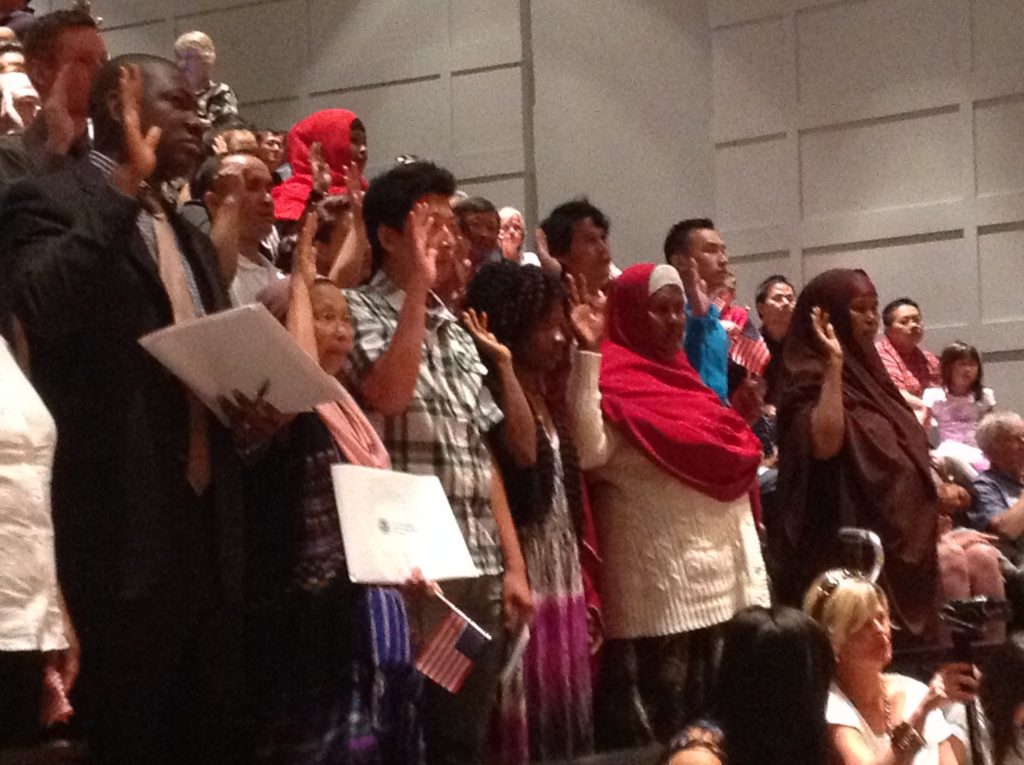
Naturalization ceremony in St. Paul, June 2014

Becoming a U.S. citizen was “a dream come true” for Norma Garza Montemayor, one of many immigrants who come to the Immigrant Law Center of Minnesota (ILCM) for help in naturalization. Citizenship applications make up the biggest category of ILCM clients, as immigrants across Minnesota share Norma’s dream.

Immigrants make up 13.5 percent of the national population but only 8.3 percent of Minnesota’s population in 2015. The “Getting to know new Minnesotans” series explores some of Minnesota’s immigration picture. Click to read:

To become citizens, immigrants go through the lengthy and expensive process of naturalization. While there are some exceptions for spouses of U.S. citizens, immigrants serving in the U.S. military, and children, the general requirements are that the immigrant applying for citizenship must:

  • Be at least 18 years of age;
  • Be a lawful permanent resident (green card holder);
  • Have resided in the United States as a lawful permanent resident for at least five years;
  • Have been physically present in the United States for at least 30 months;
  • Be a person of good moral character;
  • Be able to speak, read, write and understand the English language;
  • Have knowledge of U.S. government and history; and
  • Be willing and able to take the Oath of Allegiance.

In 2015, the most recent year for which statistics are available, 7,533 Minnesota immigrants became U.S citizens. Across the country, 730,259 immigrants became U.S. citizens in 2015.

The naturalization process starts with filing Form N-400, Application for Naturalization and paying a $725 application fee, which includes am $85 biometrics fee. After the government runs an FBI background check and reviews the applicant’s immigration history, an interview is scheduled. Applicants must pass English (reading, writing, and speaking) and civics tests.

Where do Minnesota’s new Americans come from? While the largest group of immigrants in the state comes from Mexico, the largest group of newly-naturalized citizens in 2015 came from Somalia — 1,021 new U.S. citizens from Somalia. The second-largest group (501) came from Ethiopia and the third-largest (475) from Burma. Mexican immigrants were fourth, with 425 new citizens in 2015.

These numbers reflect the changing face of immigration in Minnesota. Almost half of Minnesota’s immigrants are already citizens. While Mexican immigrants make up the largest group, many of them have been here for decades and have already become citizens.  Newer immigrants come from other countries, and make up most of the current applicants for citizenship. Here’s the full list of countries of origin for Minnesota’s naturalized citizens in 2015, from the Department of Homeland Security.

Leading countries of birth
Bhutan 91
Burma 475
Cambodia 106
Cameroon 113
Canada 98
China 211
Ethiopia 501
Ghana 78
India 316
Iraq 121
Kenya 282
Laos 371
Liberia 350
Mexico 425
Nigeria 181
Philippines 178
Somalia 1,021
Thailand 279
Ukraine 89
Vietnam 295
Other 1,951
Unknown 1

ILCM’s Minnesota Family Naturalization Project focuses on increasing the number of permanent residents in Minnesota who naturalize as U.S. citizens while also collaborating across sectors, with law enforcement and grassroots organizations, to promote the importance of citizenship. ILCM works with clients to file the citizenship application and accompanies applicants to the citizenship interview. Many naturalization cases are placed with private attorneys trained and supervised through our Pro Bono Project.

If you would like help with naturalization, you can call 651-641-1011 during the following intake hours to to schedule an appointment to speak to a legal staff member:

Monday, Tuesday, and Wednesday
9 am – 11 am
2 pm – 4 pm

If you are an attorney, and would like to volunteer to help with naturalization, you can get more information and fill out the Pro Bono application form here.

DACA will stay, but administration says no to DAPA, expanded DACA

Presentation on DACA

On June 15, the fifth anniversary of DACA, the Department of Homeland Security said that, “The June 15, 2012 memorandum that created the Deferred Action for Childhood Arrivals (DACA) program will remain in effect.”

The continuation of DACA represents a reversal of Trump’s campaign promises to repeal DACA, and will anger many of his anti-immigrant supporters. The DACA program, which has offered protection to about 800,000 young people, has wide public backing:

“But once in office, Mr. Trump faced a new reality: the political risks of targeting for deportation a group of people who are viewed sympathetically by many Americans. In some cases, the immigrants did not know they were in the country illegally. Many attended American schools from the time they were in kindergarten.”

The same DHS memorandum officially rescinded DAPA and DACA+, saying that “there is no credible path forward to litigate the currently enjoined policy.”

President Barack Obama established DACA in 2012. In 2015, he tried to expand DACA to cover more young people (DACA+) and to establish DAPA – Deferred Action for Parents of Americans and Legal Permanent Residents. (DAPA would not have covered parents of DACA recipients, because DACA recipients had no path to permanent legal residence or citizenship.)

DACA+ would have removed the requirement that DACA applicants be “under the age of 31 as of June 15, 2012.” DACA+ also allowed a three-year work permit extension, rather than the two-year extension allowed in the first DACA orders.

Texas and 25 other states sued to stop DAPA and DACA+. They succeeded, with the district court issuing a preliminary injunction, which was then affirmed by the 5th Circuit. The Supreme Court, in a one-line decision issued June 23, 2016, allowed the preliminary injunction to stand. That ruling sent the case back to the district court for trial.

The June 15 2017 memorandum from the Department of Homeland Security means that the government will not defend DAPA and DACA+ in the district court.

That leaves in place the official USCIS guidelines for DACA:

Guidelines

You may request DACA if you:

  1. Were under the age of 31 as of June 15, 2012;
  2. Came to the United States before reaching your 16th birthday;
  3. Have continuously resided in the United States since June 15, 2007, up to the present time;
  4. Were physically present in the United States on June 15, 2012, and at the time of making your request for consideration of deferred action with USCIS;
  5. Had no lawful status on June 15, 2012;
  6. Are currently in school, have graduated or obtained a certificate of completion from high school, have obtained a general education development (GED) certificate, or are an honorably discharged veteran of the Coast Guard or Armed Forces of the United States; and
  7. Have not been convicted of a felony, significant misdemeanor,or three or more other misdemeanors, and do not otherwise pose a threat to national security or public safety.

Age Guidelines

Anyone requesting DACA must have been under the age of 31 as of June 15, 2012. You must also be at least 15 years or older to request DACA, unless you are currently in removal proceedings or have a final removal or voluntary departure order…

The DHS memorandum included a link to a Frequently Asked Questions page, which has this to say about work permits:

“DACA recipients will continue to be eligible as outlined in the June 15, 2012 memorandum. DACA recipients who were issued three-year extensions before the district court’s injunction will not be affected, and will be eligible to seek a two-year extension upon their expiration. No work permits will be terminated prior to their current expiration dates.”

All of this leaves DACA recipients where they were before the June 15 DHS memorandum: with no path to legal residence or citizenship, but with temporary and limited protection, dependent on continuing presidential executive orders. And that’s not a secure position, as a DHS spokesperson pointed out in a New York Times interview:

“There has been no final determination made about the DACA program, which the president has stressed needs to be handled with compassion and with heart,” said Jonathan Hoffman, the assistant secretary for public affairs at the department. He added that John F. Kelly, the secretary of Homeland Security, “ has noted that Congress is the only entity that can provide a long-term solution to this issue.”

Want to read more?