


Judge rules in favor of sanctuary cities

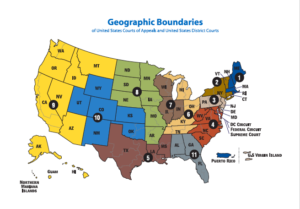
map from U.S. Courts website

In a 49-page decision on April 25, U.S. District Judge William Orrick III issued a preliminary injunction against enforcement of President Donald Trump’s executive order penalizing sanctuary jurisdictions – section 9(a) of the executive order. The order came in a case brought by the city and county of San Francisco challenging Trump’s executive order and its enforcement by federal agencies. The injunction means there can be no action against sanctuary cities under the executive order while the case proceeds to a full hearing.

Judge Orrick said it was clear that the executive order meant to withhold federal funds for more than law enforcement:

“The rest of the Order is broader still, addressing all federal funding. And if there was doubt about the scope of the Order, the President and Attorney General have erased it with their public comments. The President has called it ‘a weapon’ to use against jurisdictions that disagree with his preferred policies of immigration enforcement, and his press secretary has reiterated that the President intends to ensure that ‘counties and other institutions that remain sanctuary cites don’t get federal government funding in compliance with the executive order.’”

The preliminary injunction applies not only in San Francisco, but nationwide. The injunction “does not impact the Government’s ability to use lawful means to enforce existing conditions of federal grants or 8 U.S.C. 1373, nor does it restrict the Secretary from developing regulations or preparing guidance on designating a jurisdiction as a ‘sanctuary jurisdiction.’”

White House chief of staff Reince Priebus called the ruling “the 9th Circuit going bananas” and said the administration will appeal.

President Donald Trump told the Washington Examiner that he “absolutely” has considered breaking up the Ninth Circuit – the federal circuit that includes California, Hawaii, and seven other western states. He called the Ninth Circuit “outrageous.”

Can the president break up the Ninth Circuit? Not really – any reorganization of federal district and appellate courts would have to go through Congress. That would take a long time, and it’s difficult to see how it would make any difference in the court decisions ruling various parts of Trump’s executive orders unconstitutional.

The federal court system starts with trial courts – the 94 district courts. The latest ruling came from a federal district court in San Francisco. An appeal – if there is one – would go to the Ninth Circuit Court of Appeals. So far, the sanctuary case has not reached the Ninth Circuit.

The Ninth Circuit is one of the 13 federal appellate courts, which hear appeals from district court decisions. Twelve of the circuits are based on geographic area, with the Ninth Circuit including California, Hawaii, Alaska and six other western states. The Appeals from Ninth Circuit (or any other federal appellate court) decisions go to the U.S. Supreme Court. The Thirteenth Circuit, the Federal Circuit Court of Appeals, hears patent law appeals, some administrative matters, and other subject matters set by Congress.

For more information:


DHS: Telephone callers pretend to be immigration employees, target immigrants for identity theft


Warning! According to the Department of Homeland Security (DHS), scammers are trying to steal personal information by pretending to be immigration officials. [Para Español, haga clic aquí.] According to the DHS alert, the scammers make it seem that they are calling from an official DHS telephone number. That is called spoofing – hiding the caller’s real telephone number and making it look like they are calling from a different number. This is a way that criminals try to steal from people, and try to get personal information and commit identity theft.

The scammers calling from the DHS number pretend to be U.S. immigration employees. They demand to obtain or verify personally identifiable information. Sometimes they even say that the person they are calling is a victim of identity theft, and that they are trying to help.

If someone calls you and asks for personal information or payment, HANG UP THE PHONE.

The real DHS Hotline is used only to give out information and answer questions, never to ask you for information.

The U.S. Citizenship and Information Service (USCIS) says that anyone who wants information about their immigration case or status, can find that information in three ways:

  • Call the National Customer Service Center at 800-375-5283 to ask if you need to do anything about your case or immigration status,
  • Make an InfoPass appointment at https://my.uscis.gov/en/appointment
  • Use my USCIS to find up-to-date information about your application. <https://egov.uscis.gov/casestatus/landing.do>

The Department of Homeland Security also wants people to help in tracking the criminals who are pretending to be immigration officials. They say:

“Anyone who believes they may have been a victim of this telephone spoofing scam is urged to call our Hotline or file a complaint online via the DHS OIG website www.oig.dhs.gov. You may also contact the Federal Trade Commission to file a complaint and/or report identity theft.”

The number of the DHS/OIG hotline is 1-800-323-8603.


DHS: Estafadores fingen ser funcionarios de inmigración, y llaman a inmigrantes con el objetivo de robar su identidad

¡CUIDADO! Según el Department of Homeland Security (DHS), los estafadores están tratando de robar información personal, fingiendo ser funcionarios de inmigración. [For English, click here.] Según la alerta de DHS, los estafadores simulan que están llamando desde un número de teléfono oficial de DHS. Eso se llama “spoofing” – ocultar el número de teléfono real de la persona que llama y hacer que parezca que están llamando desde un número diferente. Esta es una manera que los delincuentes utilizan para tratar de robar a la gente, y tratar de obtener información personal para cometer robo de identidad.

Los estafadores que llaman del número de DHS fingen ser empleados de inmigración estadounidenses. Exigen obtener o verificar información de identificación personal. A veces incluso dicen que la persona que están llamando es una víctima de robo de identidad, y que están tratando de ayudarle.

Si alguien le llama y le pide información personal o le pide de pago, CUELGUE EL TELEFONO.

La Línea Directa de DHS sirve solamente para dar información y responder a preguntas, nunca para pedirle información.

U.S. Citizenship and Information Services (USCIS) dice que cualquiera que quiera información sobre su caso o sobre su estado de inmigración puede encontrar esa información de tres maneras:

  • Llame al Centro Nacional de Servicio al Cliente al 800-375-5283 para preguntar si necesita hacer algo acerca de su caso o su estado migratorio,
  • Haga una cita de InfoPass en https://my.uscis.gov/en/appointment
  • Utilice mi USCIS para encontrar información actualizada sobre su aplicación. <Https://egov.uscis.gov/casestatus/landing.do>

El Department of Homeland Security (DHS) también quiere que la gente ayude a rastrear a los criminales que pretenden ser funcionarios de inmigración. Ellos dicen:

“Se insta a cualquier persona que crea que puede haber sido una víctima de esta estafa telefónica de falsificación a llamar a nuestra línea directa o presentar una queja online a través de la página web de DHS OIG www.oig.dhs.gov. También puede contactar a la Federal Trade Commission para presentar una denuncia y / o denuncia de robo de identidad”.

El número del DHS OIG Hotline es 1-800-323-8603.

Immigrant crime victims in Minnesota find wide disparities in special visa program

“Todd Axtell had just taken over as St. Paul police chief last summer when immigrant advocates pressed him on a longtime grievance: The department has refused to back most applications for special visas that allow crime victims who help police to stay in the country.

“The advocates wanted to know: Why can’t St. Paul’s department act more like Minneapolis police?…”

Getting to know new Minnesotans – Part One: How many immigrants?

Minnesota immigrant solidarity match, 2006

A four-year-old Somali girl, rejoining her mother and sisters after being separated from them almost all of her young life. A farm worker, proudly becoming a citizen 28 years after moving from Mexico to Minnesota. A husband and wife, reunited in Minnesota 12 years after fleeing political persecution in Laos. Minnesota’s immigrants come from all over the world, and each one has their own story. Besides those individual stories, Minnesota’s immigrants are part of a larger picture. The “Getting to know new Minnesotans” series will explore some of that larger picture.

Minnesota residents include about 430,000 immigrants. About 45 percent of Minnesota’s immigrants have become U.S. citizens, but they are still counted as part of the immigrant population. Immigrants are people who were born in another country.

Compared to the country as a whole, Minnesota does not have a high immigrant population. Immigrants make up 13.5 percent of the national population but only 8.3 percent of Minnesota’s population in 2015.

Historically, that’s also a low percentage of immigrants. From 1850-1900, more than 30 percent of Minnesotans were immigrants. Then the number of immigrants dropped steadily, falling below below five percent from about 1960-2000. Since 2000, international immigration to Minnesota has increased again.[1]

Minnesota welcomes a larger proportion of refugees than the national average. According to University of Minnesota research data:

“Minnesota has received as few as 1,000 and as many as 7,000 resettled refugees annually between 1979 and 2015. On average, Minnesota has received about 2,800 resettled refugees annually over this time period. In the last five years, Minnesota has received an average of only 2,200 resettled refugees annually.”[2]

Does Minnesota have too many immigrants? Or not enough? The state demographer’s office and other researchers say Minnesota needs continuing immigration to grow — or even to maintain current population.

“Within the next three decades, the number of births in Minnesota will be eclipsed by the number of deaths—for the first time in our state’s history. When that occurs, by the early 2040s, if our state is to experience any population growth at all, it will necessarily be from migration. Over these same coming decades, the Baby Boomer generation will continue to exit the labor force, and overall labor force growth will slow nearly to a halt. Thus, our state will experience a heightened need for migration to grow at all, but especially to shore up its labor force needs.”[3]

– – – – –

[1] Allen, Ryan and Karl Schuettler. Immigrants and Minnesota’s Workforce. Minnesota: University of Minnesota, 2017, p. 13 <http://www.research.umn.edu/business/documents/OVPR%20Immigrant%20Workforce%20Development%20Report.pdf>

[2] Allen, Ryan and Karl Schuettler. Immigrants and Minnesota’s Workforce. Minnesota: University of Minnesota, 2017, p. 13 <http://www.research.umn.edu/business/documents/OVPR%20Immigrant%20Workforce%20Development%20Report.pdf>

[3] Minnesota on the Move: Migration Patterns and Implications, Minnesota State Demographic Center, January 2015, p. 3 <https://mn.gov/admin/assets/mn-on-the-move-migration-report-msdc-jan2015_tcm36-219517.pdf>

One more move against sanctuary cities – and cities resist

[UPDATE: Judge rules in favor of sanctuary cities] On April 21, the Department of Justice made another move toward penalizing “sanctuary cities.” The DOJ sent letters to nine jurisdictions “having laws that potentially violate 8 U.S.C. §1373,” telling them to provide proof that they are in compliance by June 30.

A press release accompanying the letters charged that “many of these jurisdictions are also crumbling under the weight of illegal immigration and violent crime.” Specifically, the press release charged that, “New York City continues to see gang murder after gang murder, the predictable consequence of the city’s ‘soft on crime’ stance.” New York’s mayor and police chief responded with angry denials:

“[NYC Mayor Bill] De Blasio said such remarks were “absolutely outrageous”. James O’Neill, head of New York’s police department, similarly rejected the justice department’s claims, saying they showed “a willful disregard for the facts”.

“O’Neill noted that 2016 saw the fewest shootings in New York City history since it began keeping records, and that since 1993, “murder has decreased 82%, shootings have decreased 81%, and overall crime has decreased 76%. These are the facts.”

Apart from the “immigrants are criminals” rhetoric, the letters focus on defining sanctuary cities as in violation of U.S. law. Sessions chose to begin with these nine cities  — Sacramento, Chicago, New Orleans, New York City, Philadelphia, Las Vegas, Miami, Milwaukee, New York, and Chicago —because each has a FY 2016 Byrne JAG grants from the Office of Justice Programs.

Hundreds of cities across the country have declared some kind of sanctuary. Since each city has its own ordinance, and its own federal grants, the attack has to proceed city by city.

Section 1373 says that local authorities may not order public officials to withhold information from immigration authorities about people’s immigration status. Separation ordinances, while varying from city to city, generally order local officials not to inquire about immigration status. If public officials never get the information, they cannot either supply or withhold it. (Most separation ordinances specify exceptions: officials may ask about immigration status if required by law (e.g. eligibility for food stamps) or if someone is convicted of a crime.)

Some cities are actively resisting Trump administration anti-sanctuary moves. San Francisco has sued the Trump administration, saying that Trump’s executive order is unconstitutional because it tries to make local officials enforce federal laws.  In a court hearing, the attorney for the Trump administration argued that Trump’s order was more like speaking from a “bully pulpit” and wouldn’t actually force the cities to do anything. Seattle has also sued, saying that its sanctuary city policies make the city safer for all residents.

It’s not clear how much federal money could be at stake.

Both Minneapolis and St. Paul have sanctuary ordinances.

UPDATE: U.S. District Court in San Francisco issued a preliminary injunction in city’s lawsuit against Trump executive order, stopping enforcement against sanctuary cities.

For more information:


One new citizen’s journey: Norma Garza Montemayor

Photo by Denise Krebs, published under Creative Commons license

Life is a series of journeys, especially for immigrants. Norma Garza Montemayor began a long journey in 1989, when her parents took their children from the northern Mexican state of Nuevo Leon and traveled to Minnesota.  In June 2016, Norma started a nine-month journey toward citizenship with help from the Moorhead office of the Immigrant Law Center.

Like many immigrants across time and geography, she and her family lived in a place that lacked enough opportunities to sustain them. Her parents needed to find work to support the family. Relatives and friends who already lived in Minnesota’s Red River Valley, told them about jobs as seasonal farm workers. Migrant farm workers already had been working in the Red River Valley for more than half a century. That immigrant community helped them find jobs as seasonal farm workers and settle in.

Although Norma’s parents eventually returned to Mexico, she and her siblings stayed in Minnesota.  She received legal residency under Reagan-era legislation. She met her husband in Minnesota, and they now have two teen-aged children. Both Norma and her husband work for a potato processing company. Both wanted to become citizens, and Norma started the process. She reached out to the Immigrant Law Center of Minnesota’s Moorhead office, which represented her in filing her application to naturalize.

Norma worried about failing the citizenship exam but, with the help of Martha Castañon in ILCM’s Moorhead office, she mastered the required material. Because of her limited knowledge of written and spoken English, Norma qualified for the language waiver and took her test in Spanish. “With ILCM’s help, I passed,” she said.

In March 2017, she went to Concordia College, Moorhead, raised her hand and took her oath of allegiance to the United States, proud to be a citizen. “For me,” Norma said, “it is a dream come true.”