


Meet Martha in Moorhead

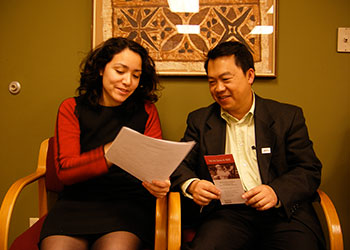
Martha Castanon (right) and Kristi Halvarson, director of Community Health Services.

A lifelong Moorhead resident, Martha Castanon is not your stereotypical Scandinavian Minnesotan. Her parents, both seasonal farmworkers, met in Comstock, a small town south of Moorhead. Her father was born in Arizona and raised in Mexico; her mother was born in Mexico and became a U.S. citizen in 1992. Growing up, Martha joined her family working in the sugar beet fields of Minnesota, picking cucumbers in Wisconsin, and working in the onion and spinach fields of Texas.

Today, Martha’s work keeps her traveling – from Moorhead to Crookston, Perham to Park Rapids, circuit riding around northern Minnesota as a legal assistant working for the Immigrant Law Center of Minnesota (ILCM).

“When I go long distances, I try to do general outreach in the area,” Martha says. That means “going out putting up flyers, going into social services, department of health, introducing myself, posting tear-off flyers at grocery stores, laundromats, gas stations, schools, and the post office. Sometimes I’ll walk the trailer courts, where it’s common to see clients living, and put up a flyer in the office.”

Bosnian, Kurdish, Iraqi, Somali and other African immigrants, as well as Latino immigrants, live and work in northern Minnesota. Her immigration caseload includes “pretty much everything.” Many permanent residents seek citizenship, which means filling out naturalization forms, practicing for interviews, and preparing for the civics test. People may need help renewing green cards (permanent residence) or petitioning for family members to join them here.

ILCM’s Moorhead office and Community Health Services work together to serve clients with intersecting medical and legal needs. In addition to Martha’s full-time presence in Moorhead, ILCM attorney Kerry McGuire works with Community Health Services as part of the legal-medical partnership. Community Health Services serves 40 counties. Its Moorhead and Crookston offices treated about 500 domestic violence patients last year. ILCM’s services include assistance with VAWA and U Visas. A battered spouse, child, or parent may be eligible for a visa under the Violence Against Women Act (VAWA). Some crime victims qualify for U visas. In addition to helping clients, Martha serves on the Community Health Service board of directors.

Martha has been working for ILCM since 2015. She opened ILCM’s Moorhead satellite office after working for 35 years for Southern Minnesota Regional Legal Services (SMRLS). She worked as a secretary for SMRLS for 17 years, and was eventually trained and hired as a paralegal. Martha developed a passion for helping people with immigration while she was working at SMRLS. “I saw how it opened doors for them once they obtained legal status or citizenship,” she says.

The ILCM office in Moorhead is in the Legal Services of Northwest Minnesota office building, as is the SMRLS Agricultural Worker Project. In November, a SMRLS attorney told ILCM staffers visiting from St. Paul that “Martha is the hardest working person in the entire building. She arrives earlier and leaves later than anyone else, and is totally dedicated to her job.”

Besides her work for ILCM, Martha volunteers with the local chapter of the American Foundation for Suicide Prevention, and is a member of the Minnesota Supreme Court Committee of Equality and Justice.  In the fall of 2016, she received Legal Services of Northwest Minnesota’s Partner in Justice Award for her skill, dedication, and impact as an advocate.

“If not me, who?”

©Fotolia

Newell Searle wants to “mobilize people to take initiatives and act on their own to help immigrants.”

Action can take many forms. For Newell, action means accompaniment, walking with immigrants who have become his friends. He tells of a woman whom he met ten years ago, when she was in deportation proceedings. After a long struggle, she has a green card and a path to citizenship. She is a business owner, and recently got an AA degree with a 4.0 average.

“There are lots of impactful things volunteers can do besides go to marches,” Newell says. For him, those “impactful things” have included writing character reference letters, writing articles for ILCM’s blog and newsletter, and going to court with immigrants.

“Going to court … was frustrating for me, at first, because I couldn’t do anything to affect the outcome. But, one of my friends said that just knowing I was there, watching, encouraged them, they didn’t feel as alone and vulnerable. For me, it was a couple hours time out of my workday. For them, my presence reinforced their determination and affirmed their worth as a person in a system that is often demeaning and demoralizing.”

If you are inspired to take action, here are some possibilities:

  • Volunteer with ILCM, either in St. Paul or in Greater Minnesota.
  • If you are a lawyer, volunteer with our Pro Bono project or with the Volunteer Lawyers Network.
  • Sign up for our Action Alerts. Then call your representatives or other, identified political leaders to ask them to take action on specific issues.
  • Spread the word. Follow ILCM on Facebook and then share news and appeals with your own friends.
  • Going to marches is not the only action, but it remains a meaningful action for many. Keep up with scheduled events in Minnesota via ILCM’s Facebook page, Navigate MN, or MIRAc..

“I did it because someone had to and if not me, who?” Newell says. If he had not responded, “I couldn’t walk away and face myself.”

Some other local organizations working with immigrants and refugees in various ways:

And in Greater Minnesota, find

Time to Protect TPS

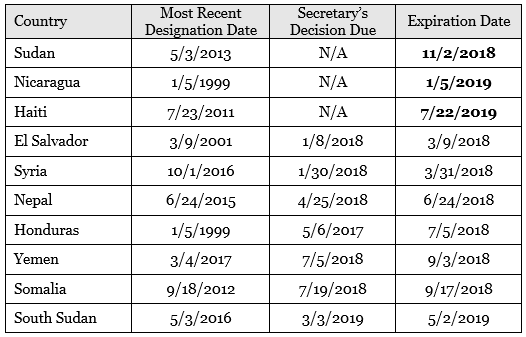
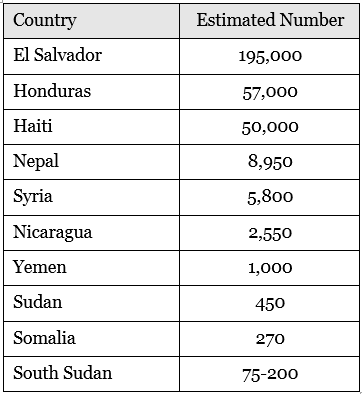
TPS numbers by country, from National Immigration Forum fact sheet.

TPS (Temporary Protected Status) and DED (Deferred Enforced Departure) are current targets of the administration’s get-tough-and-tougher immigration policy. More than 300,000 people face forced return to countries where they no longer have homes if they lose TPS or DED immigration status. The governments of several of those countries have pleaded with the U.S. government to keep TPS and DED in place, saying that their countries do not have the resources to absorb returning citizens.

TPS applies to more than 300,000 citizens of 10 countries: El Salvador, Haiti, Honduras, Nepal, Nicaragua, Somalia, Sudan, South Sudan, Syria, and Yemen. DED applies only to Liberia, and is similar to TPS.

Earthquakes, hurricanes, and civil wars can strand people outside their home countries, making it unsafe to return. TPS, established by Congress in 1990, gives people from designated countries a temporary safe haven in the United States. People with TPS receive work permission and protection from deportation.

Haitian TPS was ended by the Trump administration in November, with an 18-month delay of the effective date. Haitian TPS was granted in 2010 after a devastating earthquake. Since then, the country has endured a cholera epidemic and hurricanes. In January 2017, the State Department described conditions in Haiti:

  • “…arbitrary and unlawful killings by government officials;
  • use of force against suspects and protesters;
  • severe overcrowding and poor sanitation in prisons;
  • chronic prolonged pretrial detention;
  • inefficient, unreliable, and inconsistent judiciary;
  • governmental confiscation of private property without due process;
  • rape, violence, and societal discrimination against women;
  • child abuse;
  • social marginalization of vulnerable populations;
  • trafficking in persons;
  • violence, including gender-based violence;
  • crime within the remaining internally displaced persons (IDP) camps;
  • and widespread impunity.”

Despite all evidence to the contrary, the administration insists that Haitians no longer need TPS and can safely return home. If Haitians do not qualify for TPS, who does?

The Trump administration argues that TPS is supposed to be temporary, so they are ending it. That ignores the needs of real people from countries still struggling with huge problems.

People with TPS have lived in the United States for decades. Some 88 percent participate in the labor force, a percentage higher than that for native-born Americans. About one-third have purchased homes. Collectively, Salvadoran, Honduran, and Haitian TPS holders are parents to 273,000 U.S. citizen children – who would be forced to leave their country or lose their parents if TPS is rescinded. U.S. citizen children of Salvadoran TPS holders, for example, would move to a country with one of the world’s highest murder rates and with a 62 percent rate of un- and under-employment.

Home countries rely on remittances sent by their citizens living in the United States. In Haiti, for example, remittances make up almost one-third of the country’s gross domestic product. Still reeling from hurricane after earthquake after hurricane, Haiti’s economy remains unstable, its housing inadequate, and the country both unable to welcome its citizens home and desperately dependent on the remittances that they send. Remittances make up 18 percent of the gross domestic product in Honduras, 17 percent in El Salvador, 9 percent in Nicaragua.

Instead of ending TPS, a bi-partisan group in Congress proposes a path to permanent residence. The Miami Herald quoted Rep. Yvette Clark, one of the sponsors:

“The Temporary Protected Status program was created with bipartisan support to protect human life,” said Rep. Yvette Clarke, D-N.Y., who plans to introduce the legislation with Miami Republican Rep. Ileana Ros-Lehtinen and Washington Democratic Rep. Pramila Jayapal. “It advances American interests and values and we must work in a bipartisan manner to do the right thing and protect hardworking immigrants from being sent back to countries where their physical well being could be cast into doubt.”

TPS was a temporary, band-aid solution to a real and continuing problem. Now Congress needs to act to find a permanent solution for people who have become an integral part of our economy and communities.

This table comes from a National Immigration Forum fact sheet. Haiti, Sudan and Nicaragua have “Secretary’s Decision Date” marked as “N/A” because the Secretary has already announced permanent termination of their TPS on the dates listed.

Alianza Americas has an action guide with numbers to call and phone scripts to use in asking Congress and the administration to protect TPS holders.

Keep Fighting for the DREAM!

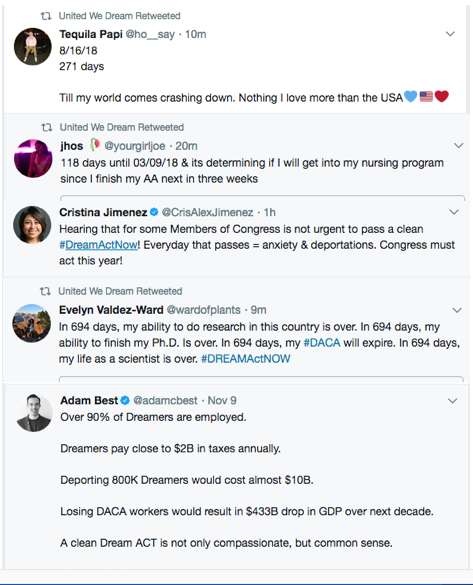
Since September 5, hundreds of thousands of DACA recipients, Dreamers and allies have been fighting for their lives – their lives here, in the homes they have made, in their schools and jobs, with their children and families. The fight continues in the courts and in Congress.
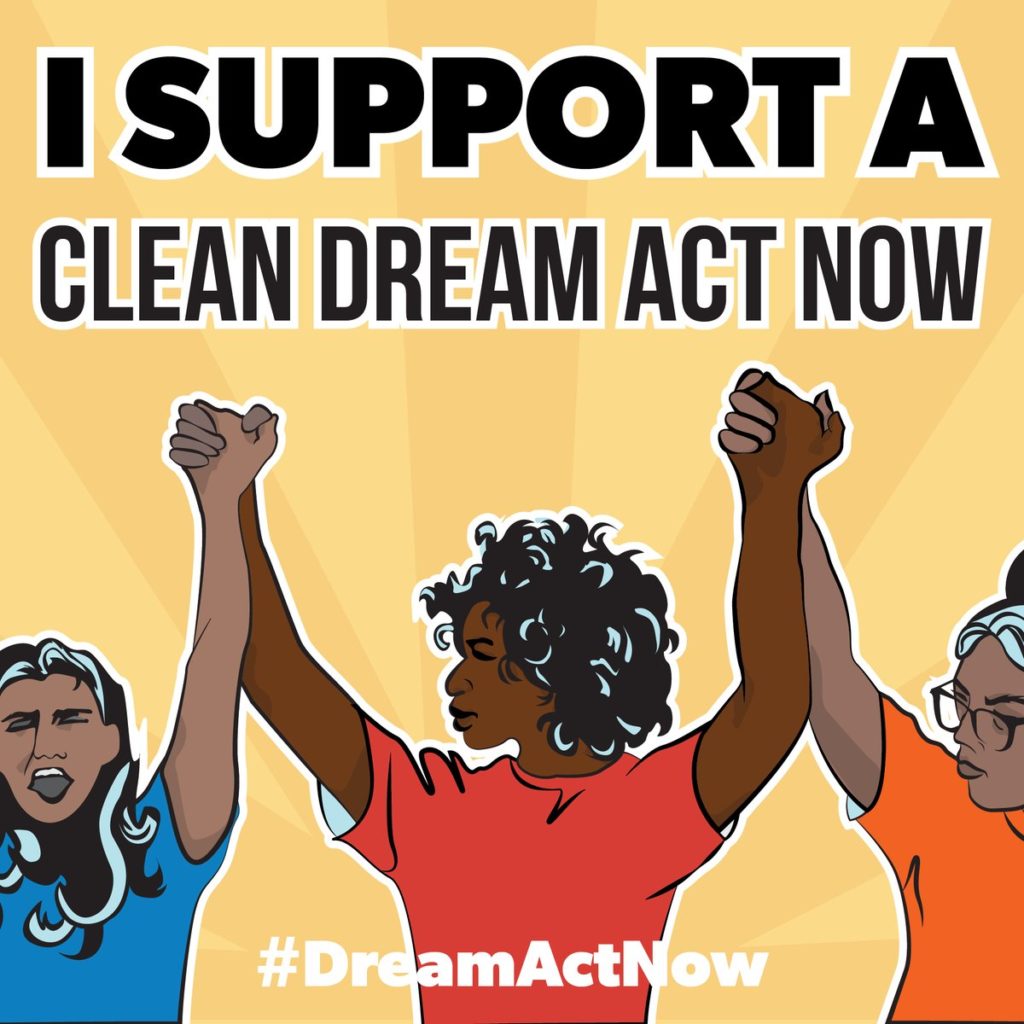
Congress can act now to safeguard Dreamers and give them a path to permanent residence and citizenship. That is what the overwhelming majority of Americans want.

Congressional leadership is delaying consideration of the DREAM Act and DACA relief. The administration continues to demonstrate the bad faith and cruelty in wrongfully denying applications for DACA renewal, detaining DACA recipients, and making hollow promises that they take back the next day.

Across the country, DREAMers and allies mobilize daily. They demonstrate in Washington and in big and small cities from coast to coast. Their phone calls and emails and text messages flood into Congress daily. They demand a clean DREAM Act – that means legislation to protect DREAMers that is not weighed down with additional measures that punish other immigrants or fund an extravagant and ineffective border wall.

The pressure is on – and members of Congress feel it.

December is crucial. Relief for DREAMers can be part of the year-end budget bill. Or it can be delayed and denied all the way through March 5, when DACA officially ends.

Every day of delay means more DREAMers losing their protection as work permits and individual DACA status expires. An estimated 122 DREAMers see their DACA status expire each day, leaving them without work permits, sometimes without valid drivers licenses, and always vulnerable to deportation back to countries they left as young children. That’s more than 10,000 DREAMers from September 5 to December 1, and more every single day.

You can help to keep the pressure on Congress to act now and pass a clean DREAM Act. Call early or late. Call often. Make sure that your representatives know the very high importance you place on protecting DREAMers through passage of a clean DREAM Act. Here are some places to start:


Immigration advocates ask Hennepin County Board for legal aid for inmates facing deportation

“Immigrant advocates asked the Hennepin County Board on Tuesday to improve the criminal justice process for county inmates facing deportation.

“The speakers, representing a coalition of immigration organizations, made their points during a discussion of the 2018 public safety budget by the board’s Administration Committee.

“They argued that people facing deportation after arrest for low-level crimes often aren’t informed of their legal rights, and too often end up in the hands of federal immigration agents without legal representation.”

Minnesota Representative Erik Paulsen urges speedy passage of legislation to protect DACA recipients

St. Paul, MN, November 10, 2017 – Republican Third District Congressman Erik Paulsen joined 13 other Republican representatives on Thursday in calling for Congressional action to protect DACA recipients. The press conference came on the day that DACA recipients and supporters flooded into Washington to demand a clean DREAM Act before the end of the year.

In a statement after the joint press conference, Representative Paulsen said:

“This morning shows once again there is a growing consensus for a solution to help young people who came to our country through no fault of their own and for all practical purposes are Americans. I will continue to support helping the 6,000 DACA recipients in Minnesota to ensure they remain valuable contributors to our state and country.”

The administration announced an end to DACA on September 5, effective on March 5. In Minnesota alone, more than 6,200 young DACA recipients arrived in this country at age 15 or younger and consider Minnesota their home.

“Thanks to Representative Paulsen for his support for a path to permanent residence and citizenship for DREAMers,” said John Keller, executive director of the Immigrant Law Center of Minnesota (ILCM). “We know that all of the DFLers in Minnesota’s Congressional delegation support DREAMers, and I believe that the other Republicans in the delegation will join with Representative Paulsen.”

The state of Minnesota needs DACA. Minnesotans with DACA pay $15 million in state and local taxes. According to the Center for American Progress, ending DACA would cost Minnesota more than $367 million in annual GDP losses. We currently are experiencing historic waves of older workers leaving the workforce. According to the Humphrey Institute and Greater MSP’s January 23, 2017 report, we not only need to keep every last DREAMer in MN – but we need to expand the rate of immigration to Minnesota to maintain our current economic standard of living.

On October 26, chief human resource officers for 110 major corporations urged Congress to pass DACA legislation quickly, and to recognize the crucial role played by foreign-born workers in the U.S. economy. Minnesota corporations signing on to the letter to Congress included Target, Mayo Clinic, EcoLab, 3M and Medtronic. The letter concluded

“America’s international competitors understand that attracting workforce talent from around the world is vital to economic success, and many are rewriting their immigration policies accordingly. Some have gone so far as to say that the United States’ reticent attitude toward foreign workers has created an opportunity for other countries to secure the economic benefits derived from those workers. As Congress and the administration consider proposals for changes in the immigration laws and/or enforcement strategies regarding existing laws, we urge you to consider these benefits to American workers, companies, communities, and the American economy.”


Contact:

John Keller, Executive Director
Immigrant Law Center of Minnesota
450 North Syndicate Street, Suite 200
St. Paul, MN 55104 St. Paul, MN 55104
(651) 641-1011
john.keller@ilcm.org (cell: 651-428-1402)

FFI:


Irish, Italians, Uzbeks and the “Diversity Visa” program

The biggest winners in the Diversity Visa Lottery are private companies that make big bucks from hopeful would-be immigrants – who have less than a one-half-of-one-percent chance of success.

The Diversity Visa Lottery came under attack this week when Trump called for its abolition because accused terrorist Sayfullo Saipov emigrated to the United States through that program seven years ago. Here’s a quick summary of when and why the Diversity Visa Lottery began, what the program is today, and why it has nothing to do with terrorism:

Why a Diversity Visa Lottery? Some history …

The original Diversity Visa Lottery, also known as the green card lottery, reserved 16,000 of its 50,000 annual visa quota for Irish immigrants. That was a pretty big clue to its origin: dissatisfaction of European-Americans with the low number of European-American immigrants in the 1980s.  European immigrants had dominated U.S. immigration for centuries, from the 1600s all the way to the 1950s.

BBC and Vox quoted Tweets by CUNY Brooklyn College political science professor Anna Law, explaining

“The program was created by powerful and well placed Italian and Irish American Senators and Reps to help their co-ethnics immigrate.

“It was pork barrel legislation designed to benefit very specific groups. The lottery was created w/ a formula to make eligible only persons from nations who had sent a small # of peeps to the US; it obviated the need for family ties/job skills. The “diversity” language was window dressing and branding to sell it. Was politically smarter a label than a visa for “peeps with no family ties or job skills.”

The stated purpose of the lottery was providing visas to people from “countries with historically low rates of immigration to the United States.” In this case, “historically low” referred to the five-year period before the visa application, not to the history of the United States. The Irish preference expired, and now the Diversity Visa Lottery allows no more than 7 percent of the visas to go to any single country.

The Diversity Visa Lottery passed in 1990 as part of a bigger immigration bill, approved by a House vote of 264-118 and a Senate vote of 89-8. President George H.W. Bush signed the bill, which had wide, bi-partisan support.

How the Diversity Visa Lottery works today

Most people around the world have no way to apply for a U.S. permanent resident visa – if they are not close family members of a U.S. citizen or permanent resident, skilled professionals with a  job offer waiting and an employer willing to go through an extended visa process, or refugees waiting years for placement, they have no way to even apply. That’s why millions of people – nearly 14.7 million in 2016 –take a chance on the Diversity Visa Lottery. Only 50,000 winners are chosen each year, so that gives each applicant less than a one-half of one percent chance of winning.

If you are from a country that sent more than 50,000 immigrants to the United States in the past five years, you cannot apply for a diversity visa. Right now, that means no applicants from Bangladesh, Brazil, Canada, China (mainland-born), Colombia, Dominican Republic, El Salvador, Haiti, India, Jamaica, Mexico, Nigeria, Pakistan, Peru, Philippines, South Korea, United Kingdom (except Northern Ireland) and its dependent territories, and Vietnam. Only applicants from an eligible country can apply.

Besides coming from an eligible country, applicants have to have at least a high school education or “two years of work experience within the past five years in an occupation that requires at least two years of training or experience to perform.”

Applicants must file online. The entry period for the 2019 visa lottery runs from October 18-November 22, 2017. (That’s a change – the original entry period was October 3-November 7, but a “technical issue” required throwing out all the entries made prior to October 10, so the time period was re-set)

Once the applications are in, the State Department conducts a computerized lottery to choose the lucky winners – who are then eligible to pay the fees and apply for a visa, but are not guaranteed acceptance. They have to go through the usual extensive application process, security checks, personal interviews, etc. that are required of every visa applicant.

Remember – that’s 14.7 million entries in the visa lottery and only 50,000 winners. Better odds than the Powerball, but still pretty steep.

Nothing to do with terrorism – but still not a great idea

If you are a wanna-be terrorist, the Diversity Visa Lottery seems like a strange route to make. First, you enter a lottery with a less than one-half of one percent chance of winning. Then you go through extensive background checks and personal interviews and wait for at least two years, probably more, for a visa. That doesn’t sound like a plausible terrorist plan.

Of course, that doesn’t make the program a good idea. Giving out visas by lottery does not endanger the country, but it also does not serve any obvious goal of immigration policy.