




Press Release: Trump Administration Revokes Temporary Protected Status for Salvadorans

January 8, 2018 – Today, the Trump administration announced an end to Temporary Protected Status (TPS) for nearly 200,000 Salvadoran immigrants. TPS holders from El Salvador will be forced out of the United States by September 9, 2019, forced back to a country beset by violence.

The Immigrant Law Center of Minnesota (ILCM) has opened our Helpline for Minnesotans affected by this action, with hours from 3-5 p.m. from Tuesday, January 9 through Friday, January 12. The number for the Helpline during those times is 651-287-3715.

“This is more than a human tragedy for the Salvadoran TPS holders, their families, and communities,” ILCM Executive Director John Keller said. “The termination of TPS for Salvadorans, which follows similar terminations of TPS for people from Nicaragua, Sudan, and Honduras, exemplifies the racist and xenophobic anti-immigration policies of this administration. This decision completely disregards the violence within El Salvador and the very real dangers to returnees. It also ignores the length of time that Salvadorans have resided in the United States and the degree to which they are integrated and valuable members of U.S. communities.”

ILCM has worked with hundreds of people with TPS for the last 17 years. We will do everything we can to help those eligible to transition to a different status. That is not possible for most people with TPS, who will need Congressional action to let them stay here.

Of the Salvadorans residing in the United States with TPS:

Only Congressional action can reverse this travesty and allow TPS holders from El Salvador to remain here with their U.S. citizen children, in the homes they own, in the jobs that contribute to the U.S. economy, in the communities where they are essential and valuable members. We urge every Minnesotan to contact members of our Congressional delegation to urge them to support legislation establishing permanent resident status for Salvadoran TPS holders.

DACA and Dreamers: Down to Decision Time

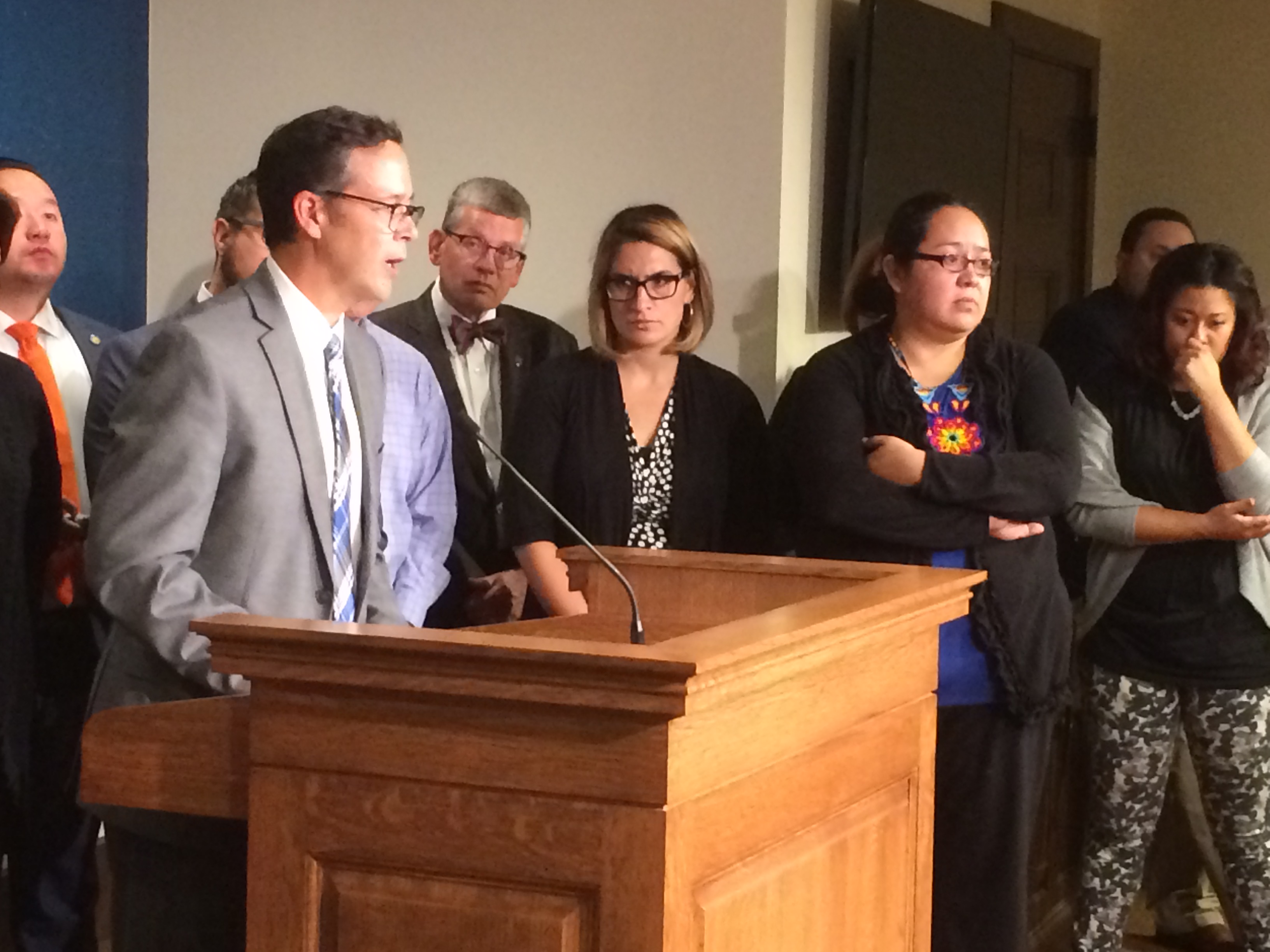
DACA press conference, September 5, 2017

January 19 is the next crucial decision date for DACA and Dreamers. That’s when funding for running the government runs out, unless Congress passes an extension. To pass an extension, Republicans need some Democratic votes in the Senate. That gives Democrats leverage to demand a clean Dream Act in exchange for their votes to keep the government open.

Time is running out for DACA recipients – 122 per day, about 14,000 since September 5 are losing DACA protection. After March 5, the number losing DACA protection—and subject to immediate deportation—jumps to about 1,000 per day. Even if Congress passed a Dream Act today, full implementation would take an estimated seven months. In the meantime, no one trusts the Trump administration to hold off on deporting Dreamers, no matter what the law says. Continue reading

Press Release: Despite Congressional Inaction, Dreamers Are Here to Stay

St. Paul, December 22, 2017—Yesterday, Congress refused to pass a clean Dream Act that would have allowed nearly 800,000 young Dreamers a peaceful holiday season. Congress ignored thousands of people who have filled the streets of Washington and their own offices for weeks, demanding a clean Dream Act now, before the end of the year. They ignored the plight of 122 young Dreamers who become deportable each day that passes, almost 15,000 in total by the time Congress returns to Washington in January.

“We are deeply disappointed by Congress’s failure,” said John Keller, executive director of the Immigrant Law Center of Minnesota, “but this is not the end. Every new poll shows solid and growing support for Dreamers, across the country, among Democrats and Republicans. This year’s Congressional inaction is a setback but not a defeat. The Dreamers are here to stay.”

We need the skills, hard work, energy, courage, dreams, and imagination of young immigrants. Minnesota families, small and large cities, faith communities, colleges and universities, businesses and farms need thousands of young immigrants to remain in Minnesota; they in turn need Congress to pass a clean Dream Act in the first days of 2018.

Minnesota’s dreamers and allies showed inspiring courage and persistence over the past weeks. The struggle continues, past the disappointment of yesterday’s vote and into the new year. They will not give up now. We will not give up now

Here’s a New Year’s resolution for everyone who cares about these young people: Resolve to call your Congressional representatives on January 2 and 3 and every day until they pass a clean Dream Act, and give these young people permanent protection and a path to citizenship.

x x x

The Immigrant Law Center of Minnesota (ILCM) is a non-profit organization that provides immigration legal services to clients of all nationalities throughout Minnesota. ILCM’s work is based on a three-pronged model—direct legal services, education, and advocacy

Minnesota Business Immigration Coalition joins nationwide call for Congress to act now, beginning with Dreamers

On December 8, the Minnesota Business Immigraiotn Coalition joined the national iMarch for Immigration Campaign, calling on Minnesota’s congressional delegation to take action to protect Dreamers, and more. Here is the press release announcing their action:

The Minnesota Business Immigration Coalition today joined the national iMarch for Immigration Campaign. Business leaders called on Minnesota’s congressional delegation to take action protecting Dreamers as a first step to addressing longstanding economic hurdles within the nation’s outdated immigration system.

“New Americans are significant and substantial contributors to the development and growth of Minnesota’s economy,” said Bill Blazar, senior vice president of public affairs and business development at the Minnesota Chamber of Commerce. The Minnesota Chamber leads the Minnesota Business Immigration Coalition. “Immigration reform should tune our system to the 21st century world economy.  It will help our new Americans contribute more than they now do and propel our state’s economy forward.”

The virtual march for immigration reform has broad-based support – leaders in the business, agriculture, education, tech and faith sectors; state and local elected officials; and top voices across the political spectrum. The campaign is launching as Congress negotiates a much-needed solution for recipients (i.e. Dreamers) in the Deferred Action for Childhood Arrivals (DACA) program.

Immigrant workers are important to companies of all sizes and types across the state, Blazar noted. Hear firsthand in these videos on the need for immigration reform:

  • John O’Reilly, vice president, Otten Bros. Garden Center & Landscaping, Long Lake.
  • Pat Lunemann, partner and general manager, Twin Eagle Dairy, Clarissa.
  • Maha Tahiri, vice president, chief health and wellness officer, General Mills.

Perry Aasness, executive director of the Minnesota AgriGrowth Council and a member of the Minnesota Business Immigration Coalition, underscored the value of immigrants to Minnesota’s economy. “From our experience, it is clear that new American workers are critical to our state’s economy, and in particular, a wide variety of agriculture sectors. Agriculture is a driving force in Minnesota’s economy, and farmers and food producers rely on immigrant workers.”

The state coalition includes the Minnesota Chamber, Minnesota Agri-Growth Council, Minnesota Nursery & Landscape Association, Hospitality Minnesota, Minnesota Milk Producers Association, Midwest Food Processors Association, Minnesota Restaurant Association and Minnesota Lodging Association.

The nationwide campaign is spearheaded by the New American Economy, which brings together more than 500 Republican, Democratic and Independent mayors and business leaders who support immigration reforms that will help create jobs for Americans today.

NAE cited the impact of immigrants on Minnesota’s economy and the effect of the DACA-eligible population in the state as key reasons for Congress to take immediate action. In Minnesota alone, the positive economic impact of DACA-eligible recipients can be easily seen:

  • There are as many as 9,973 DACA-eligible recipients in the state.
  • Despite the rhetoric claiming undocumented youths are a drain on the Minnesota economy, 91.9 percent of the DACA-eligible population who are at least 16 years old are employed.
  • Minnesota’s DACA-eligible population earns almost $154.8 million in total income annually.
  • Minnesota’s DACA-eligible population contributes more than $24.1 million in total taxes annually, $12.2 million of which goes to state and local tax revenues.

At large, immigrants have substantial impact on the Minnesota economy:

  • Immigrants pay $3.7 billion in taxes every year.
  • Immigrant-owned businesses employ 52,932 people.
  • Immigrants held $10 billion in spending power in 2016.

For more information on the iMarch Campaign, visit iMarch.us.

Hawaii v. Trump: Defending Against Travel Ban’s Assault on “Our Nation’s Most Basic Commitments”

On December 6, the Ninth Circuit heard arguments in Hawaii v. Trump, a case challenging the latest version of the Trump travel ban/Muslim ban. You can listen to the entire argument on C-Span. Attorney Neal Katyal, representing travel ban opponents, gave a particularly eloquent, short summation, which begins around 58:50 in the C-Span video:

“Tomorrow will have been two years to the day since Donald Trump called for a complete and total shutdown of all Muslim immigration to the United States.

“It will also be another sad anniversary, 76 years since the devastating attack on Pearl Harbor. Pearl Harbor led not only to an assault on our nation’s security but also an assault on its most basic commitments. The walls of this very courthouse where Gordon Hirabayashi was tried bear witness to that tragedy.

“What the government did then in the name of national security did not make us stronger. It betrayed our values. It betrayed our nation’s soul and rather than defend those values, the court stood by then.

“Twice now, this court, reflecting the dissents in those cases, not the majority, has made sure not to repeat that mistake and to avoid the nightmare of Judge Gould’s hypothetical of a federal court system that is powerless.

“This court has twice asserted its vital role as guardians of the law, and rejected the president’s attempt to flout our constitution, to flout our laws. We ask that this court do so again.”

Defending Immigrants in Hennepin County

“You have the right to remain silent. Anything you say can and will be used against you in a court of law. You have the right to speak to an attorney, and to have an attorney present during any questioning. If you cannot afford an attorney, one will be appointed to represent you.”
If you are charged with shoplifting a carton of cigarettes, you have a right to remain silent and a right to an attorney. Your maximum sentence is 90 days in jail and a fine of up to $1000. Your likely sentence is much, much less – probably no jail time at all. Nonetheless, you have a constitutional right to an attorney and, if you cannot afford an attorney, to having an attorney appointed to represent you.

If you are charged with entering the United States without permission, you are likely to lose your home, your job, and your family, and to be deported and barred from returning for at least 10 years. If you cannot afford an attorney, you are out of luck – you have no constitutional right to a public defender.

On December 6, by a 4-3 vote, Hennepin County Commissioners said that immigrants will have a right to a public defender in deportation cases in Hennepin County.

Criminal court rules and procedures are complicated. Immigration court rules and procedures are exponentially more complicated. As MPR reported :

“Those without legal representation are less likely to fight their cases and more likely to be deported. Only about 14 percent of undocumented immigrants have representation, according to immigration lawyers.”

Hennepin County is taking a stand for immigrants. The budget amendment, introduced by Commissioner Marion Green and passed by the County Commissioners, will provide representation to immigrants who are facing deportation and cannot afford to pay an attorney.

That’s a big step forward in helping immigrants make their cases in deportation proceedings. The second big step is an order that immigrants being booked into Hennepin County jail be told of their right to refuse to talk to immigration officers — their right to remain silent, their right not to get on the  phone with ICE.

“We have overwhelming anecdotal evidence that residents aren’t given this information,” [Greene] said. “And are often kind of immediately, at a very vulnerable moment in the process, put on the phone with an ICE agent or made to go talk to an ICE agent in a room that they have at (the) county jail.”

Sheriff Rich Stanek coordinates with ICE in many ways, including the jail policy of putting any immigrants on the phone with ICE as they are processed into the jail. The County Commissioners can’t order the sheriff not to do that. They did vote to require that immigrants be told of their right to refuse to talk to ICE and that they get access to attorneys. Those are two big steps toward a higher standard of justice for immigrant defendants in Hennepin County.

We Need a Clean DREAM Act NOW!

St. Paul, December 5, 2017 – Since September 5, hundreds of thousands of DACA recipients, Dreamers and allies have been fighting for their lives – their lives here, in the homes they have made, in their schools and jobs, with their children and families. What they need – what we all need – is a clean DREAM Act now. That means legislation to protect DREAMers that is not weighed down with other punitive immigration provisions or funding for an extravagant and ineffective border wall.

Congress can act now to safeguard DREAMers and give them a path to permanent residence and citizenship. That is what the overwhelming majority of Americans wants.

Congressional leadership is delaying consideration of the DREAM Act and DACA relief. The administration continues to demonstrate bad faith and cruelty in wrongfully denying applications for DACA renewal, detaining DACA recipients, and making hollow promises that they take back the next day.

This week DREAMers and allies are demonstrating in Washington and across the country. Many Minnesota corporations and colleges support passage of the Dream Act. Others are marching, telling their stories, and calling on Congress to act. NavigateMN is also leading a multi-racial, multi-sector coalition action at Congressman Erik Paulsen’s office on Wednesday, December 6 at 3:30 to ask his support for a clean DREAM Act.

We need the skills, hard work, energy, courage, dreams, and imagination of young immigrants. In Minnesota alone, the end of DACA devastates close to 7,000 young people – all of whom have or will have a high school diploma, are in or graduated from college, or are working in jobs that pay them better because they have DACA. Their average age when they arrived in the United States was 6 years old, and they have lived here an average of 20 years. In Minnesota, these young people between the ages of 15 and 35 live in every Congressional District in the state and come from dozens of countries.

Every day of delay means more DREAMers losing their protection as work permits and individual DACA status expires. An estimated 122 DREAMers see their DACA status expire each day, leaving them without work permits, sometimes without valid driver’s licenses, and always vulnerable to deportation back to countries they left as young children. That’s about 11,000 DREAMers losing DACA protection since September 5, and more every single day.

December is crucial. Relief for DREAMers can be part of the year-end budget bill. Or it can be delayed and denied all the way through March 5, when DACA officially ends.

We urge every person, business, faith community, school, and organization who cares about these young people – and who cares about what they bring to our state and nation – to contact your Congressional representatives and demand that they pass a clean Dream Act NOW, and give these young people permanent protection and a path to citizenship. Minnesota’s Congressional delegation can lead the way by showing bipartisan unity in demonstrating leadership to pass permanent protection for our DREAMers.

x x x

The Immigrant Law Center of Minnesota (ILCM) is a non-profit organization that provides immigration legal services to clients of all nationalities throughout Minnesota. ILCM’s work is based on a three-pronged model—direct legal services, education, and advocacy

The Advocates for Human Rights, a 501(c)(3) organization, creates and maintains lasting, comprehensive, and holistic change on a local, national, and global scale. Volunteers, partners, supporters, board members, and staff implement international human rights standards to promote civil society and reinforce the rule of law.

NAVIGATE MN is a non profit grassroots organization building power for immigration and education justice. Our theory of change centers the realities of undocumented Minnesotans and mixed status families. Navigate MN has education, civic engagement and civic leadership programs.

Deferred Action for Childhood Arrivals (DACA), begun by President Barack Obama in 2012, offers limited protection to young people who arrived in the United States at age 15 or younger and have been here since 2007 or earlier. DACA status offers two years of protection from deportation and a two-year work permit. Renewal of DACA status has been permitted every two years. DACA status does NOT offer any path to permanent legal residence or citizenship.