Yes—it’s happening here in Minnesota, too. The racist taunts target immigrants, all people of color—and Native Americans, too.


Yes—it’s happening here in Minnesota, too. The racist taunts target immigrants, all people of color—and Native Americans, too.
The president gets to set the annual ceiling on refugee admissions. He wants it to be zero.
The new rule bars all asylum seekers who pass through Mexico (or any other country) on their way to the U.S.

Contact: Melissa Pfeiffer, Associate Director, ILCM, 651-641-1011 ext. 201
SAINT PAUL, MN, July 19, 2019 —The Immigrant Law Center of Minnesota (ILCM) has selected Veena A. Iyer, JD as our new executive director. Iyer will begin at ILCM on September 9th.
“In this time in our nation’s history, it is vital to defend and advance the rights of immigrants and refugees in our communities,” said Iyer. “The Immigrant Law Center of Minnesota has long been at the forefront of these efforts in the Upper Midwest, and it is my privilege to join this team.”
ILCM board chair Irma Márquez Trapero welcomed Iyer to the team, saying, “We at ILCM have a big task ahead of us to not only continue to provide exceptional legal support, but also to continue to act boldly as community leaders at a time when our immigrant and refugee communities are targets of hateful and racist attacks. Veena Iyer is an outstanding and fearless advocate and we are excited to have her lead ILCM into the future.”
Serving immigrant and other underserved populations is a passion for Iyer. She began her career as an Equal Justice Works Fellow and staff attorney at Legal Aid Chicago (formerly the Legal Assistance Foundation of Metropolitan Chicago), where she represented clients, created and managed a legal clinic for low-income immigrant students, and conducted English and Spanish presentations for community members and service providers. In Minnesota, Iyer has represented low-income clients as a pro bono attorney with ILCM, Tubman and Standpoint.
Iyer has worked at the Nilan Johnson Lewis law firm since 2011, and was named shareholder in 2015. She is the chair of the Diversity & Inclusion Working Group at the firm, received Minnesota Lawyer’s Diversity & Inclusion Award in 2018, and was named to the Minnesota Super Lawyers list in 2019. She is licensed to practice law in Minnesota and Illinois.
An active community leader, Iyer is a past president of the Minnesota Asian Pacific American Bar Association, is a member of the organization’s Advisory Board and its Judicial Committee, and received the organization’s Leadership Award. She has held numerous board roles with Minnesota Women Lawyers and was honored with the Service to MWL Award. She also serves on the board of directors at Portico Healthnet as vice chair and member of the Finance Committee.
Iyer’s educational background includes a BA in History from the University of Chicago (with honors) and a JD from Harvard University, cum laude. She speaks conversational Spanish and Tamil and basic Russian.
(For a printable PDF version of this Fact Sheet click here.)
What is Asylum?
An asylee, a person granted asylum, is a person who has to flee their country of origin due to persecution, or fear of persecution, based on their race, nationality, political opinion, religion or membership in a particular social group. While asylum is not a permanent legal resident status, asylees may apply for a green card one year after receiving asylum in the United States.
Asylees receive protection from being returned to their country of origin, are authorized to work in the United States, may apply for a social security number, and may petition to bring family members to the United States.
What is the normal asylum process?
U.S. asylum applications may take two forms: affirmative and defensive. An asylum applicant must be physically present in the United States or at a port of entry to apply. They may apply regardless of how they entered the country.
Under the affirmative asylum process, individuals must usually apply within one year of arrival to the United States, or immediately upon arrival at a port of entry. An affirmative application is made to a United States Citizenship and Immigration Services (USCIS) officer, who then decides whether to grant asylum.
In the defensive asylum process, individuals can seek asylum as a defense against removal after U.S. Immigration and Customs Enforcement (ICE) or Customs and Border Protection (CBP) apprehends them without a valid visa inside the United States or at a port of entry. A person in the defensive asylum process is already in removal proceedings and requests asylum in immigration court. An immigration judge decides whether or not to grant asylum.
If a USCIS officer denies an affirmative application after the individual’s visa has expired, the individual is referred to removal proceedings where they can use the defensive asylum process to renew their request for asylum.
A person subject to expedited removal must indicate that they have a credible fear of returning to their country of origin. The “credible fear interview” is ordinarily conducted by a trained USCIS officer. However, in the summer of 2019, the administration ordered that credible fear interviews will be conducted by Border Patrol officers.
If the officer says that the individual does not have credible fear, authorities refer them for removal. They can then appeal the negative decision to an immigration judge.
How long does the asylum process take?
The length of the asylum process varies from six months to several years. The length of time needed to process an application depends significantly on whether it is an affirmative or defensive claim, and on the individual circumstances of the case. Under the defensive system, applicants must go through the immigration court system, which faces significant backlogs. According to the Transactional Records Access Clearinghouse, as of July 2019, there were over 900,000 pending cases with an average wait time of 727 days. The backlog continues to worsen with funding for immigration judges failing to keep pace with the need to hire more judges.
What are the acceptance rates?
In FY 2018, 22,740 individuals were granted asylum, about 35 percent of the 64,974 individuals who underwent asylum decisions. Most asylum seekers come from China, El Salvador, Honduras, Guatemala and Mexico.
Denial Rates
Denial rates on asylum decisions increased in 2018, with 65 percent of asylum petitions denied, compared to a 42 percent denial rate in 2012 and a 50 percent denial rate in 2016. In 2018, Attorney General Jeff Sessions ordered that claims of domestic violence and gang violence could no longer be used as a basis for asylum applications. That order was one of the reasons causing the rate of asylum denials to increase during the Trump Administration.
Applicants who have attorneys have a far higher approval of asylum petitions, compared to those without representation. The process is extremely complicated, and navigating immigration courts without an attorney is difficult.
Applicants who are held in detention have lower rates of approval of their asylum claims than those who are free in the community. Locating documents, witnesses and evidence needed to support an asylum claim is extremely difficult for an applicant who is held in detention.
How is asylum changing?
In January 2019, the Department of Homeland Security implemented the “Migrant Protection Protocols” (MPP) also known as “Remain in Mexico”, sending asylum seekers back to Mexico and forcing them to wait there for the completion of their immigration court proceedings. This, in effect, denies asylum seekers the protection allowed to them under international and U.S. immigration law. In many cases, asylum seekers in Mexico face the very dangers they fled, as well as having difficulty in finding places to stay and in making contact with attorneys or getting notice of court dates.
Metering
Metering is a term that Customs and Border Protection uses for a process by which it severely restricts the number of people who can request asylum at a port of entry or at a U.S.-Mexico border crossing each day. When asylum seekers reach a port of entry, they are turned away and told that they have to put their name on a waiting list. As a result of these lists, asylum seekers wait for weeks, sometimes months for an opportunity to request asylum. As of late June 2019, 19,000 asylum seekers were waiting on the Mexican side of the border for a chance to request asylum in the United States. After going through the metering process, asylum seekers then seek asylum, but most are required to remain in Mexico while the U.S. government processes their asylum application. Metering has resulted in potential asylum seekers crossing the border without authorization rather than waiting for a process that is rife with corruption and uncertainty.
Ending Asylum at the Southern Border
On July 15, 2019, the Trump administration issued a new regulation that effectively ends amnesty for any migrants arriving at the U.S. – Mexico border if they have traveled through another country. The new rule covers everyone except Mexican and Canadian citizens. The rule denies people who have traveled through a third country any opportunity to apply for asylum in the United States unless they have applied for and been denied asylum in that third country. The rule nullifies national and international obligations to protect asylees.
Several organizations, represented by attorneys from the ACLU, Center for Constitutional Rights, and Southern Poverty Law Center, filed a lawsuit on June 16 asking a federal court to declare this regulation invalid and enjoin the administration from enforcing it.
Other pending lawsuits challenge the metering and Remain in Mexico policies.
July 15, 2019 – The new rule posted by the Trump administration effectively ends asylum in the United States. This blatant violation of human rights and U.S. and international law cannot be allowed to stand.
“We are totally abrogating our international responsibilities through this regulation,” said Lenore Millibergity, interim executive director of the Immigrant Law Center of Minnesota (ILCM). “We are condemning people who are in fear of their lives to possible death. Every time that the United States has denied asylum to entire classes of desperate refugees in the past, we have had to look back in shame at such decisions. We must say no to this inhumane and illegal attempt to end asylum in the United States.”
The new regulation says that any asylum seekers coming through a third country will be barred from applying for asylum in the United States. That means only Mexicans, Canadians, and people arriving in small boats or swimming to our shores would be allowed to apply for asylum.
This regulation makes a mockery of U.S. asylum law, which says that time spent in a third country only bars people passing through a designated “safe third country” or having “firmly resettled” in a third country. Neither Mexico nor any Central American country is designated as a “safe third country” for the very good reason that none of these countries is safe.
Despite the dangers asylum-seekers face, this administration’s inhumane and illegal “Remain in Mexico” policy already sends them back to danger in Mexico. According to Doctors Without Borders, “more than 45 percent of 378 patients treated by MSF in Nuevo Laredo [between January and May] have suffered at least one episode of violence in the city, as they waited to cross into the US.” U.S. immigration authorities send vulnerable refugee families to Tamaulipas, despite U.S. State Department warnings of crime and kidnappings there. The State Department warnings advise against all travel in Tamaulipas, placing the state at the same risk level as Syria and Afghanistan.
“Neither this appalling new regulation nor the inhumane ‘Remain in Mexico’ policy can stand,” Millibergity said. “The courts must act, and swiftly, to protect not only asylum seekers but also the rule of law in the United States.”
In Morrison County—Trump country—local farmers rely on Hispanic labor, and the president’s deportation push is starting to bite.
Two full-time staff members transitioned into new positions at ILCM this spring and in June we welcomed 15 summer interns.
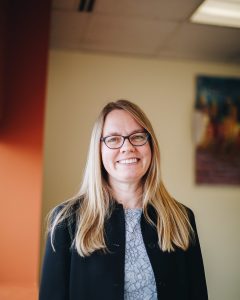
Jennifer Stohl Powell began working as ILCM’s legal director in June. Jennifer is an experienced immigration attorney and has handled cases at ILCM for refugees and domestic violence and crime victims for the last two years. Before ILCM, she worked at Southern Minnesota Regional Legal Services (SMRLS) for over 20 years and supervised SMRLS’ immigration and farm worker unit for 13 years. She is a graduate of Carleton College, the University of Minnesota Law School, and she holds a master of arts degree in nonprofit management from Hamline University. Jennifer states that ”she is thrilled to serve ILCM staff and clients in this new role.”
In May, Griselda Gurrola transitioned into the full-time position of volunteer coordinator. Griselda has worked at ILCM since October 2017 as a receptionist. Previously, she worked for more than two years with two private attorneys. She is also currently enrolled in the Paralegal Program at Inver Hills Community College.
Along with these staff changes, ILCM welcomes 15 summer interns. Among them:

Ana Delgado joined ILCM as a law clerk under interim executive director Lenore Millibergity. She is currently studying law at the University of Minnesota. An immigrant herself, Ana is passionate about ILCM’s mission and looks forward to working one-on-one clients.
Amalia Chiapperino is one of the five interns assisting with Detainee Legal Assistance calls. A senior at Macalester, Amalia is finishing her bachelor’s in international studies with an Arabic minor. After graduation she is interested in pursuing law school to work in human rights or immigration law. She joined ILCM with the hopes of learning new skills and serving the Minnesota immigrant community.
ILCM also said goodbye to Margaret Martin and to Sandra Portilla who graduated from the University of Minnesota and is beginning a new career path in family and social services.
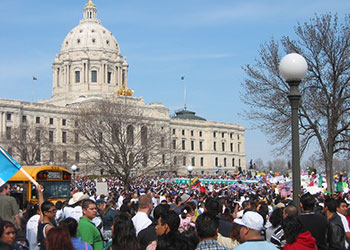
More than 1,000 people marched and chanted down Lake Street in south Minneapolis on Sunday afternoon demanding an end to federal immigration raids and policies that separate children from their families.