



Archives
On MLK Day, Albert Lea Residents Draw Comparisons Between Civil Rights Movement, Immigration
MLK Day Promotes Inclusivity
Albert Lea Residents Draw Parallels from MLK to Current U.S. Immigrations Issues
As shutdown continues, thousands of immigration court hearings have been canceled
The government shutdown has drastic consequences for immigrants waiting for their court dates in Minnesota.
Challenge and Opportunity in 2019

In the past two years, we have seen that policies and practices can be changed even without Congressional action or actual changes in the laws. We will continue to support immigrants and refugees, and to fight back against anti-immigrant policies. In Minnesota, drivers licenses and municipal ID will be on state and local agendas, along with privacy issues arising from both. At the federal level, protection of immigrants comes before both Congress and the courts: DACA, TPS, asylum, the border, and more.
Driver’s licenses
Currently, Minnesota blocks residents who are undocumented immigrants from obtaining driver’s licenses. And yet, it is nearly impossible to live in Minnesota without driving. Without a driver’s license, seemingly everyday tasks like picking up children from after-school activities or driving to the doctor’s office can result in potentially life-altering consequences. For undocumented residents, something as minor as being pulled over for a burned-out headlight can trigger a series of events that results in separation from their families and the loss of their homes and livelihoods. That uncertainty traumatizes children and takes a deep toll on families and communities. As part of a broad-based coalition, ILCM is advocating for driver’s licenses for all legislation in this year’s Minnesota legislative session.
Municipal ID
Northfield began issuing municipal IDs last June, joining more than 20 U.S. cities or counties, including Milwaukee, Chicago, Los Angeles, and Detroit. Minneapolis voted last year to begin issuing municipal IDs, but is still in the planning stages.
Many undocumented residents face barriers to obtaining critical services as a result of not having a government-issued form of identification. Those services include opening a bank account, filing a police report, obtaining prescription medication for themselves or their children, and picking up children from school.
Municipal IDs offer one way to show that a city welcomes immigrants. Funding deportation defense for city residents is another important step. We support all welcoming city initiatives, including expansion of municipal IDs, state legislation to safeguard privacy of personal information, and local funding for deportation defense.
Comprehensive Immigration Reform
Likely to pass? Not really, but it’s important to remember and focus on this big picture. Our immigration system is broken. Immigrants wait for years for decisions on their petitions, for their spouse’s or children’s place in line to move forward, for their case to be heard by an immigration judge. Just one example: after a U.S. citizen pays the fees and files all the paperwork for their unmarried adult son or daughter to get a green card, the son or daughter must wait for seven to 21 years before their number comes up. (And if the unmarried son or daughter is a national of one of the Muslim ban countries, the petition will be denied.)
We also have 10-11 million undocumented people living in the United States, most of whom have lived here for more than a decade, building lives and families and contributing to their communities. We all need them to have a path to legal residence.
Dreamers and TPS
Both DACA recipients and people with Temporary Protected Status have had minimal protection from deportation and work permits. The Trump administration ordered those protections removed for all DACA recipients and most TPS holders. Congress needs to pass legislation to protect current DACA recipients and all Dreamers who came to this country as children and know this country as their home, and to give them a path to permanent legal residence. Congress also needs to protect TPS holders, who have lived here for decades and whose countries are still unsafe for return, and to give them a path to permanent legal residence.
Asylum
U.S. law protects asylum seekers and gives them the right to ask for refuge here. The Trump administration has tried to stop asylum seekers from even asking for admission, has removed protection for victims of domestic violence and gang violence, and has insisted on jailing asylum seekers for years while their cases languish in an overburdened and backlogged immigration court system.
We will continue to push in both Congress and the courts for the protection of asylum seekers, as already guaranteed in U.S. law.
Deportation Budget
Under previous presidents, undocumented immigrants with serious criminal records were prioritized for deportation, Under this administration, everyone is a priority: a child with cerebral palsy, a father caring for his handicapped son, even permanent residents with minor criminal convictions. People with DUI convictions are now a major category of deportation cases.
To support this contrary-to-common-sense deportation policy, the administration is asking for major increases in funding. Congress must deny these increases and insist on a return to reason.
The Border
We do not need a border wall or soldiers at the border. The number of undocumented immigrants crossing the border has fallen dramatically since 2000, and continues at a lower level than in earlier years, contrary to all the heated rhetoric from the White House. We do not need to militarize the border to stop people who want to turn themselves in to U.S. authorities and ask for asylum. We need more capacity at the border to process asylum seekers and release them to await their hearings.
A Sweet and Hoppy New Year

Dulceria Bakery’s sweet support of the Immigrant Law Center of Minnesota (ILCM) brought us through December and into the new year. Dulceria Bakery, a woman-owned, person-of-color owned, immigrant-owned small business in South Minneapolis, describes its business model as “being intentional about not-gendering people, recognizing multiculturalism as an asset, partnering with local, immigrant, BIPOC and LGBTQIA vendors and entrepreneurs, together as a comunidad…and baking the best pastries with a Mexican twist!” Dulceria Bakery supported ILCM with a donation of 10 percent of their holiday sales. ¡Mil gracias!
Thank you, also to Fair State Brewing Cooperative for choosing ILCM as their nonprofit partner for January through the Fair State Cooperates Program! Throughout the month, 10 percent of all Crowler sales will go towards supporting ILCM’s work in the community. Stop by Fair State sometime in January and support ILCM!
The annual Give To The Max Day in November brought in more than $22,000 from about 270 donors—thank you! Thanks also for your generous response to our year-end appeal, with more than $60,000 in donations.
We appreciate the small business support and imagination, and the ways that you continue to find to support our work. One friend posted on Facebook that he supports us through Amazon Smile. If you shop through Amazon, that’s a painless way to get a corporation to donate to ILCM, and the pennies per purchase can add up to make a difference.
We continue to be grateful for all of your support. You know we face major challenges as immigration policies become more restrictive and punitive. We will always stand with immigrants and refugees, and your support makes our work possible.
Visionaries Documents the Immigrant Law Center of Minnesota

Visionaries, an award-winning public television series hosted by Sam Waterston, chose us as an organization to feature in a television documentary! They came to Minnesota to film during the week after Thanksgiving, visiting Moorhead, Austin, and Worthington, as well as St. Paul and Minneapolis. We are excited about the wonderful stories that they have to tell, highlighting immigrants and refugees, the issues of immigration today, and ILCM’s history and work.
Visiting us, they met lawyers, immigrants, refugees, and past and present board members. In St. Paul, they watched a naturalization ceremony for a client from Romania, and heard about the wonderful support that ILCM’s Martha Castañon gave to the family throughout the process. They interviewed a DACA recipient about his family and the help he had received from ILCM, and his current studies at the University of Minnesota. Visiting Dulceria Bakery in Minneapolis, they learned firsthand how Dulce works to create “a cozy, family-oriented space where intersectionality and inclusion are an everyday experience for each one of our customers, employees, and partners.”
In Moorhead, they met Martha in person, and saw the farm where she had picked cucumbers as a child, as well as sugar beet fields and plants. In Austin, Maylary Apolo showed them her family’s grocery store and introduced them to traditional Burmese holiday foods of Sweet December. Sara Karki explained how ILCM works collaboratively with partners in the Austin Area Minority Business Project.
A winter storm gave them a taste of Minnesota as they traveled on to Worthington, where they met Joyce Bennett Alvarado and Erin Schutte Wadzinski and experienced the Spanish Mass at St. Mary’s and an informational forum on immigration afterward.
Over the last 23 years, Visionaries has captured the stories of more than 150 nonprofit organizations in every corner of the world. The Visionaries series airs on public television stations across the country. We can’t wait to see how they show and tell the story of ILCM and immigrants and refugees in Minnesota. We hope to premiere the documentary in the fall of 2019 in the Twin Cities.
Welcome and Farewell: Winter Staff and Board Transitions

As we begin 2019, we welcome new staff and newly-elected board officers, and say farewell to two staff members who are moving on. Among the moves in ILCM over the winter: Julia Decker and Salma Ahmed will leave ILCM in January, and Tim Sanders Szabo, Stacey Brake, and Maggiy Emery joined the team.
New officers were elected to the board of directors in January: President – Irma Marquez Trapero; Vice-President – Maya Salah; Treasurer – Grant Ostler; Secretary – Kate Wasylik.
Stacey Brake joined ILCM as a staff attorney with her husky, Deems, who has quickly become quite a busy and popular new team member. With a background in criminal defense, Stacey finds ILCM an energizing organization doing vital work. Years ago, at a Catholic Worker house on Chicago’s South Side, she learned how to teach yoga through the originality and integrity of the kids she befriended there. She studied Sociology and Spanish at the University of San Diego which also presented opportunities for exploring how positive change and progress can happen. She attended law school at Saint Louis University, in her home state of Missouri, and served as public defender immediately following her graduation.
Maggiy Emery joined ILCM as a development associate in 2018 after several years working in finance and campaign fundraising, including positions with former Minneapolis city council member Gary Schiff, Minnesota’s second Congressional district Representative Angie Craig, and Minnesota’s first Congressional district candidate Dan Feehan. She also spent time as a program officer with The Open Door, working to provide food security in the south suburbs of the Twin Cities.
Tim Sanders Szabo graduated from the University of Minnesota Law School in 2018. While in law school, he was a student attorney and then a student director in the Federal Immigration Litigation Clinic where he represented clients in Immigration Court, before the Board of Immigration Appeals, and argued cases at the U.S. District Court and the Eighth Circuit Court of Appeals. As the recipient of an Equal Justice Works Fellowship sponsored by 3M and Faegre Baker Daniels. Tim focuses on establishing medical-legal partnerships with clinics in North and South Dakota, working with ILCM attorneys, staff, and pro bono counsel to increase access to legal assistance for underserved non-citizens in those areas.
Salma Ahmed has helped many, many people who otherwise likely would not have secured legal representation to gain green cards, citizenship, work authorization, travel documents, and other legal relief. Each of these people has found, through Salma’s work, their way to greater security as residents or citizens of the United States. She also has reached many refugees and others at locations most convenient and comfortable to them and their families, and has provided a place for people to safely and confidently seek information and assistance. The ripple effect of Salma’s work is immeasurable and surely will persist.
Julia Decker’s advocacy, primarily for clients at risk of deportation, has made immeasurable difference in their lives and the lives of their families. Logging hundreds of miles driving to detention centers and immigration hearings, she has been the lifeline for people in danger of being separated from their families, communities, jobs, homes, and country. She has unflaggingly represented her clients even in those cases when it seemed futile. Whether her clients won in court or not, and no matter how isolated they were, they knew that they were important enough for her to spend time and energy fighting for them.
Update on ILCM Transition
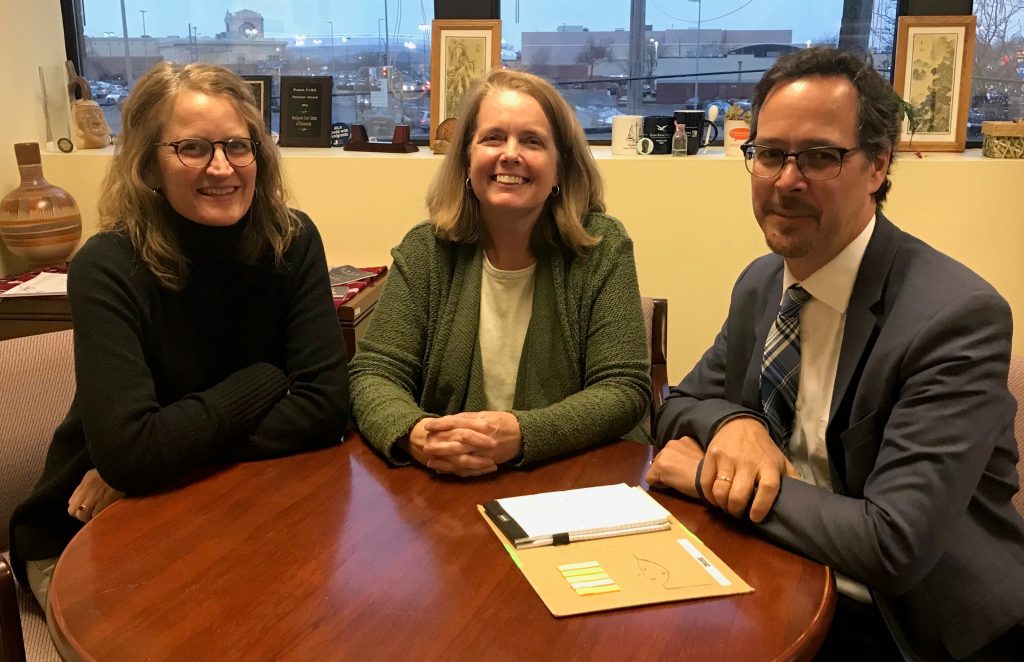
As John Keller leaves ILCM on January 31 to become Minnesota’s Chief Deputy Attorney General, Lenore Millibergity steps up as acting executive director.
“I couldn’t think of anyone better than Lenore,” Keller said. “She hired me, and has been my rock whenever I needed help and support, whether in an individual case or on policy issues.”
Millibergity began working for Oficina Legal, which later became the Immigrant Law Center of Minnesota, in 1987. She worked first as a staff attorney and then as supervising attorney. In 2005 she received Centro Legal’s Advocate for Justice Award for her service to the Latino community. She also received the Minnesota State Bar Association’s 2013 Bernard P. Becker Legal Services Staff Award.
Jenny Stohl Powell, who has decades of experience in immigration law and has worked with ILCM in the recent past, agreed to come back to work with the legal team.
The board of directors has approved a search committee. They plan to hire an outside firm to conduct a national search, which is expected to take three to six months. Founding directors Bill Mahlum and Karen Ellingson will work with the board and transition team.
“I have no reason for anything but optimism for the future once we get through the transition and the challenge of change,” said Keller. “With a strong staff and systems in place, and with a culture of getting things done, ILCM will continue to serve immigrants and refugees and the community throughout this transition and long into the future.”
Want to keep up with the latest news from ILCM? Like us on Facebook, and follow us on Twitter and Instagram.