
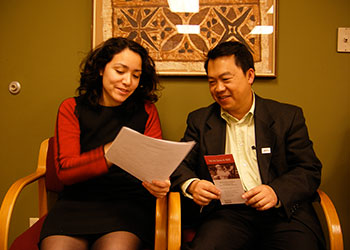



The Trump administration’s anti-immigration strategy includes delay and denial at a rate never before seen.
Archives
Freedom to Drive Coalition Statement Following Passage of HF1500 in the Minnesota House

SAINT PAUL — Following the Minnesota House passing HF1500, the driver’s license for all bill, the Freedom to Drive coalition released the following statement:
“We are excited that the Minnesota House has heard the voices of Minnesota families. This unprecedented moment was only possible because of the thousands of Minnesotan families who have been fighting for over a decade to make this happen. We know that driver’s licenses for all means safer families and more prosperous communities. Issuing licenses to undocumented immigrant families is a major step toward recognizing the full dignity of all Minnesotans. We look forward to working with the Senate and Governor Walz and getting this law passed this legislative session.”
BACKGROUND: In 2003, then-Governor, Tim Pawlenty changed the rules and barred the state from issuing driver’s licenses to undocumented immigrants. For the past ten years, impacted community members and advocates have worked to restore driver’s licenses for undocumented immigrants. This year’s effort is backed by a coalition of non-profit organizations, unions, immigrants’ rights advocates, community-based groups and collectives, faith-based organizations, workers’ rights advocates and businesses led by the Multiracial Coalition on Immigration.
###
Full List of Freedom To Drive Coalition Members
Accountability in Action (St Cloud)
ACLU
Advocates for Human Rights
Asamblea de Derechos Civiles
Asian American Organizing Project
Black Immigrant Collective
CAIR-Mn
Citlalcoatl
City of Mpls, Office of Immigrant and Refugee Affairs
City of St Paul Mayor Carter’s office
Club Cuernavaca
COPAL
CTUL
De Leon & Nestor, LLC
Education Minnesota
Hunddle for Action, Annandale (St Cloud)
Immigrant Law Center of Minnesota (ILCM)
Immigrant Movement for Justice
Indigenous Roots
Inquilinxs
Interfaith Coalition on Immigration (ICOM)
ISAIAH
Jewish Community Action
Kalpulli Elohuayotl Mitotiani
Kalpulli KetzalCoatlicue
Kalpulli Yaocenoxtli
KetzalCoatlicue
LCD SPPS
LOVE HOPE RISE
MIM
Minneapolis Regional Labor Federation
Minnesota Budget Project
Minnesota Nurses Association
MIRAC
MN AFL-CIO
MN Council on Latino Affairs
Morena Minnesota
NAPAWF (St Cloud)
Navigate Mn/ Unidos MN
Organization
Peace Unite Church of Christ (St Cloud)
Proyecto Latino
Release Mn 8
Rice County Neighbors United
SEIU- local 26
SEIU- State Council
Sembrando Poder
Social Concerns, Caridades Catolicas (St Cloud)
Unite Here! Local 17
United Food and Commercial Workers (UFCW) 663
University of Minnesota Legal Clinic
Vecinos Sur del Rio
Vecinos Unidos Rochester
Voices for Racial Justice
Women’s March Minnesota
Facts About Family-Based Immigration

(For printable PDF of this Fact Sheet, click here.)
Family Reunification is a Key Principle of Immigration Law
- Immigration policy emphasizes four major principles: 1) family reunification, 2) skills-based immigration, 3) refugee protection and 4) country of origin diversity.
- Family reunification has been a key immigration policy since the late 1800s. In the 1920s, nativist prejudices changed the law to require national origins quotas, drastically reducing levels of immigration into the United States.
- In 1965, Congress passed the Immigration and Nationality Act (INA), which made changes to immigration based on employment quotas and national origins quotas, and put in place a system of immigration which favored family reunification. The Act granted 74 percent of all permanent visas to family reunification categories.
- The changes enacted in the 1965 INA resulted in a more diverse group of nationalities immigrating to the United States. In recent years, Mexico, the Philippines, China, India and the Dominican Republic have sent the largest number of immigrants based on family reunification.
How Family-Based Immigration Works
- Each year, the U.S. government issues 480,000 family-based visas.
- There is no limit to the number of visas issued to immediate relatives of U,S. citizens who are over 21. “Immediate relatives” of U.S. citizens are spouses, unmarried children under 21, and parents. The number of visas granted to immediate relatives of U.S. citizens is subtracted from the overall 480,000 family-based quota.
- To ensure that all family-based visas are not used by immediate relatives of U.S. citizens, Congress sets a minimum number (usually 226,000) that must be allotted through other family-based preference categories. Other family preferences include unmarried adult children of U.S. citizens, spouses and children under 21 and unmarried adult children of permanent residents, married children of U.S. citizens, and brothers and sisters of adult U.S. citizens.
- S. citizens and legal permanent residents cannot sponsor other family members such as grandparents, cousins, uncles, or other extended family members. These limits and the long wait times disprove the “chain migration” myth.
- The law also prohibits any single country from receiving more than 7 percent of the total number of visas issued in a single year.
- Family-based immigration currently makes up two-thirds of all legal permanent immigration. Each year, the number of family members petitioning for lawful permanent resident status exceeds the total number of family visas set by the 1965 INA. Wait times for available family-based visas can extend for years, particularly for persons from countries with many petitioners, such as India, China, Mexico and the Philippines.
- The visa queue has grown to approximately 4 million persons who qualify as family-based immigrants but who must continue to wait. As of January 2019, some visa petitions for relatives from the Philippines and Mexico have been waiting for 23-24 years.
Why Maintaining Family-Based Immigration is Important
- Reuniting families is not only humane, but also recognizes that for many people, families are a source of emotional and economic support contributing to stability and stronger communities.
- Having strong family support networks increases the odds of immigrants and their U.S.-born children reaching their highest potential.
- According to the National Immigration Forum, the percentage of new businesses started by immigrants went from 13.3 percent in 1997 to 28.5 percent in 2014. New immigrants revitalize rural areas and cities such as Boston, Detroit, and Baltimore and have been crucial to technological success stories in Silicon Valley and across the country.
Deferred Enforced Departure (DED) for Liberians Extended
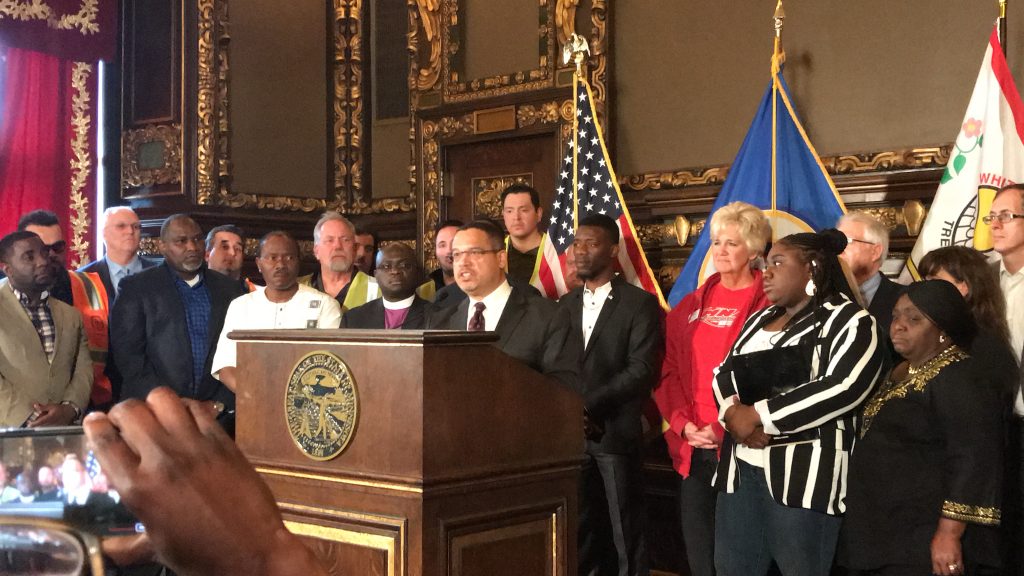
On March 28, 2019, the Trump administration announced it would extend Deferred Enforced Departure (DED) for one more year.
Liberian refugees fleeing Liberia’s civil war were first authorized to stay in the United States in 1991 under Temporary Protected Status (TPS) through President George H.W. Bush. In 2007, President George W. Bush continued the protection of Liberians in the United States by implementing DED. Initially intended to last 18 months, extensions of DED continued for eligible Liberians until March 31, 2018 when the Trump administration decided DED was no longer necessary. The wind-down period was to last a year and DED would officially end on March 31, 2019.
Isabella Wreh-Fofana said she screamed with joy when she heard the news, and then proceeded to call everyone she knew. At the press conference planned in defense of DED, she stated, “I’m grateful for the extension, but we need a permanent solution.”
Furthering Isabella’s message, Minnesota House Speaker Melissa Hortman said:
“We can’t have families keep returning to this place of extreme stress and wondering what the future will hold. Liberians protected under DED need an opportunity to apply for permanent residency. We talk a lot about Minnesota values, and this is part of that. In Minnesota we care about our neighbors, and our Liberian neighbors are Minnesotans. We are going to continue to stand with them.”
Minnesota Attorney General Keith Ellison, who has been a key figure in the support of a lawsuit by Liberians, said, “Making people ride this roller-coaster year after year is inhumane, hurts families and wreaks havoc on our economy and communities. It’s no way for any Minnesotan to live.” He went on to highlight how integral the Liberian community is in Minnesota’s healthcare system.
While DED status for Liberians is extended automatically through March 30, 2020, employment authorization (EAD) was only extended through September 27, 2019. Anyone who may continue working during all or part of the full 12 month DED extension needs to file a new I-765, and should see an immigration attorney.
Next week, they may have to leave behind their kids and the place they love
Minnesota’s Liberian diaspora community is among the largest in the nation, if not the world.
Twin Cities senior care facilities brace for loss of Liberian immigrant workers
Ending Deferred Enforced Departure (DED) for Liberians will have a dramatic effect on Minnesota’s health care industry.
Dream and Promise Act
UPDATED May 13, 2019 – The Dream and Promise Act, introduced as H.R. 6 by Rep. Lucille Roybal-Allard (D-CA), and Reps. Yvette D. Clarke (D-NY) and Nydia M. Velazquez (D-NY), would protect Dreamers and recipients of Temporary Protected Status and Deferred Enforced Departure by providing them with a pathway to citizenship.
More than two million immigrants now live with the uncertainty of DACA (Deferred Action for Childhood Arrivals), TPS (Temporary Protected Status), and DED (Deferred Enforced Departure), threatened with termination of status and deportation. Liberian DED status, previously scheduled to end at the end of March, was extended at the last minute to 2020. While the administration has ordered an end to DACA and to protection for most TPS recipients, those orders are currently being challenged in courts across the country. All of the people living with DED, TPS, and DACA need the protection of a pathway to citizenship, rather than the uncertainty and fear of short-term statuses and a constant quest for extensions.
Lenore Millibergity, acting executive director of the Immigrant Law Center of Minnesota (ILCM) said:
“We need these immigrants. They have lived in the United States for decades, worked here, built homes and families here, and continue in so many ways to strengthen and enrich this country. Not only do we need their contributions: in fairness and justice, we owe them the protection of permanent legal residence and a path to citizenship.
“It’s time for Congress to act.”
No action has been taken on the Dream and Promise Act since its introduction and referral to committees. Congress needs to act now, rather than allowing these statuses to expire during the volatile 2020 election season.
Ninth Circuit Appeals Court Grants More Protections to Asylum Seekers
The 9th Circuit said asylum seekers can appeal denial of credible fear determination. This will end up in Supreme Court.
Congratulations to former ILCM board member, now Judge Adam C. Yang!
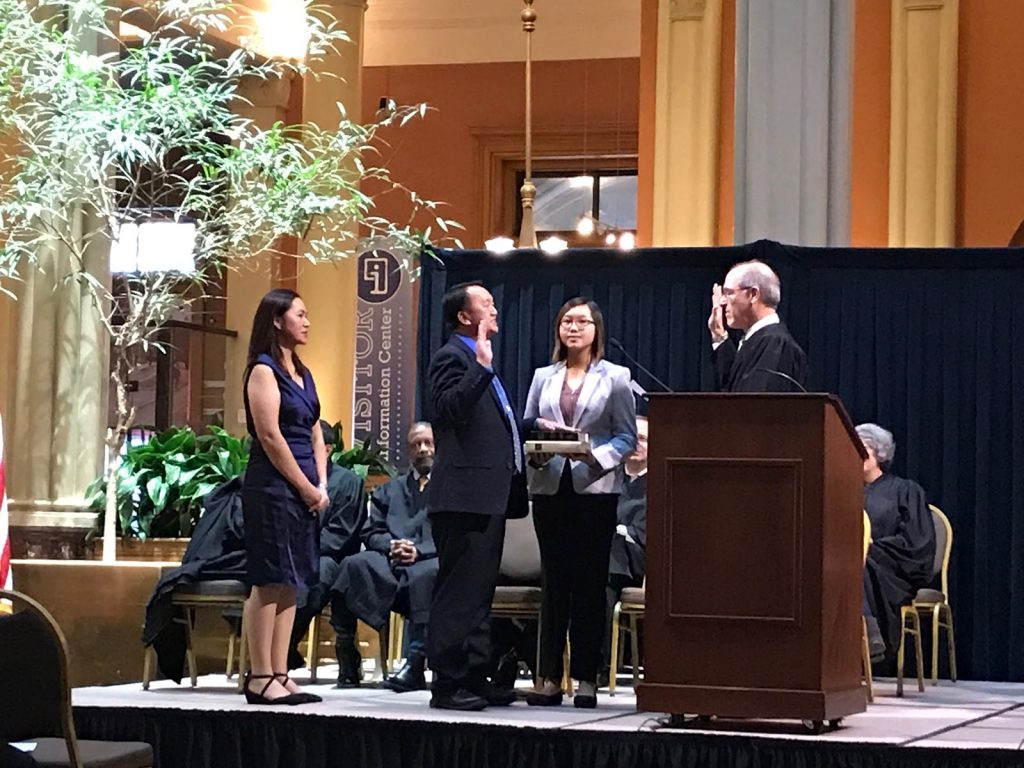
At an investiture ceremony on January 17, 2019 Adam Yang was officially sworn in as a Ramsey County District Judge. He joins Judge Sophia Y. Vuelo and Judge P. Paul Yang as Minnesota’s third Hmong judge.
Yang is a former board member at ILCM. Before his election in November, Adam Yang served as a public defender in Hennepin County working in the Juvenile Justice Unit.
The ceremony began with “America the Beautiful” sung in three-part harmony by Neuchee, Mandy, and Jannie Chang. The opening remarks were given by The Honorable John H. Guthmann, Chief Judge, Second Judicial District. Comments were shared by Caryn Boisen, President of the Ramsey County Bar Association, and The Honorable Anne McKeig of the Minnesota Supreme Court, both of whom spoke of the strong feelings associated with “coming home.” McKeig noted, that home is “where our heart and soul always remain.”
“[Adam Yang] has the demeanor, he has the wisdom, he has the humanity, he has the people skills, and he understands the plight of those who come before the court,” said McKeig. “That itself is a gift to our legal community.”
Yang took his oath with two bibles, one in English and one in Hmong. His wife, Theresa, helped Yang into his robe and his daughter, Audrey held the bibles.
In his remarks, Yang echoed McKeig’s sentiment toward returning to the Second Judicial District. He said it is a “great place that echoes the voice of great judges past and present … I am home, in the place I started my legal profession.”
“I want people who come through my court … to know and feel that they’re being treated fairly,” he said. “That they are heard and respected.”
Yang ended his remarks by thanking his family and wife, “Behind a great man is a great woman. Behind a greater man is the greatest woman.”
Time Is Running Out: DED, DREAMers, and TPS
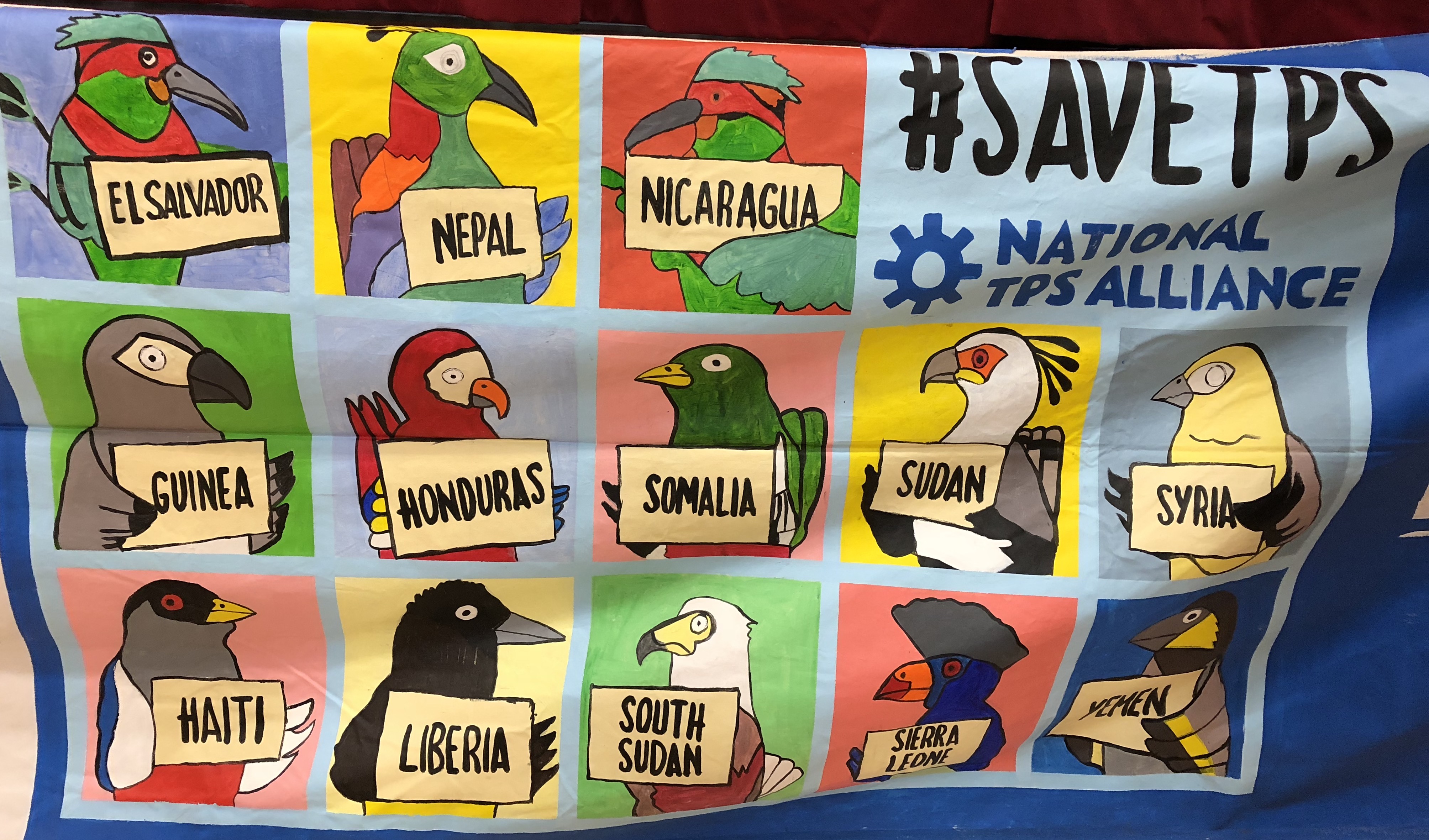
March 8 2019—Nearly a million people live in the United States with the constant uncertainty of TPS, DED, and DACA status. While each is different in some details, all of these statuses provide temporary permission to live in the United States, with no path to permanent residence (green card) or citizenship. The Trump administration is trying to end all of these statuses. Some of its efforts have been delayed or stymied, in part, by lawsuits and court orders.
Deferred Enforced Departure (DED) status for Liberians ends on March 27, by order of the Trump administration. When DED ends, they will lose their work permission, Minnesota driver’s licenses, and their permission to stay in the United States. They will be vulnerable to deportation—away from the lives, homes, and families they have built over the past two decades.
Temporary Protected Status (TPS) holders from El Salvador, Haiti, Nicaragua, Sudan, Nepal, and Honduras also face an end to their status. A federal judge enjoined DHS from terminating TPS status for residents of Sudan, Nicaragua, Haiti, and El Salvador. That gives more than 300,000 people a temporary reprieve for as long as the injunction lasts. TPS for Hondurans will end on January 5, 2020, and TPS for Nepal will end on June 14, 2019. Some residents of South Sudan, Syria, Somalia, and Yemen also have TPS, with varying dates for expiration or extension.
While the administration is unsympathetic to the plight of TPS holders already in the United States, it is considering extension of TPS to Venezuelans.
DACA holders and DREAMers saw the administration try to end their status back in 2017. The courts ordered that people who already had Deferred Action for Childhood Arrivals (DACA) on or prior to September 5, 2017 could keep and extend their status, at least while litigation continues. No new DACA applications are allowed, which means that hundreds of thousands of DREAMers (immigrants who entered the United States without authorization as children) who had not yet been granted DACA status have no way forward.
According to the Miami Herald, members of the Congressional Hispanic Caucus have introduced legislation to provide a pathway to citizenship for DREAMers, and people with TPS and DED. Whatever the eventual fate of that legislation, it’s not going to pass in time to help Liberians with DED. They are in an even more precarious position, as DED status depends entirely on Trump: DED is a discretionary protection status enacted by the president.
DED holder Yatta Kiazolu, a PhD candidate at UCLA who has lived for 22 of her 28 years in the United States, testified at the House Judiciary Committee hearing on March 6. Her full testimony is available here. She said in part:
“25 days from now Liberian DED will end and my entire life will be interrupted. I have only visited Liberia once as a toddler and I have never lived in the country.
“I am here today to appeal to Congress to create a permanent solution on behalf of myself and the thousands of Liberians who have rebuilt their lives here in the United States. …
“I have been a recipient of both TPS and DED. If DACA had not been rescinded it is possible that I would have been a Dreamer, as well. The protection of these relief programs allowed me to maintain a stable and healthy life, despite living deadline to deadline. …
“Nothing I have accomplished thus far would be possible without the unwavering support of my family, who are here with me today. I am here because of the love and labor of my mother, grandmother, and aunties who, when I first arrived, were all working class Black immigrant women. They worked jobs that required them to stand on their feet for sometimes over 10 hours a day in order to protect me and offer me space to imagine, dream, and explore my world as a child should. Their resilience, hope, and lessons about goodwill inspire my graduate research about histories of Black women’s political activism . My grandmother used to say “When you do good, you don’t do it for yourself, you do it for God.”[pause] And with that philosophy as my personal mantra, though the majority of my family are now permanent residents and U.S. citizens, I am here for all the working class immigrants on DED, TPS, and are also DREAM-eligible. I am here for all young people like myself who have anxiety about their futures.
“If Congress allows DED to end in 25 days, I do not know what will happen to me.”
Yatta Kiazolu speaks not only for herself, but for nearly a million other immigrants whose lives depend on continuation of TPS, DED, and DACA—and ultimately, on what only Congress can do: creation of a path to citizenship for them.
You can call Congress and ask for a path to citizenship for Yatta and for all immigrants with TPS and DED and for all DREAMers.